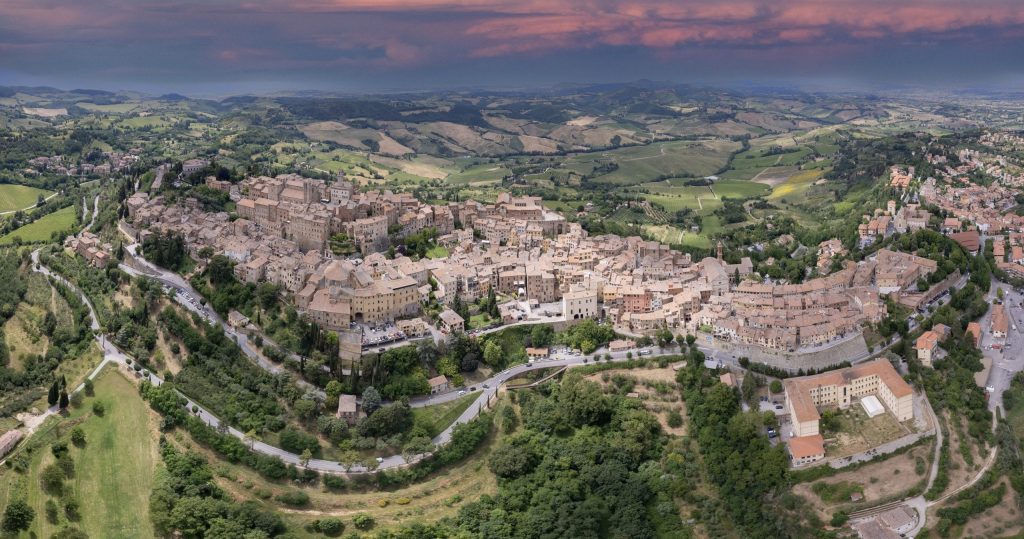
Montepulciano sits on a limestone ridge at 605 metres, overlooking two of the most beautiful valleys in Italy: the Val d’Orcia to the south, the Valdichiana to the east. They called it “the pearl of the Cinquecento.” The architecture and the wine are both extraordinary.
A Town Shaped by Greatness
The town’s origins are Etruscan, but its golden age came under Medici rule in the 16th century, when it attracted the finest architects of the Renaissance — Antonio da Sangallo the Elder, Vignola, Peruzzi, Michelozzo, and Ippolito Scalza. Their work gave the town a refinement that outlasted the Medicis by centuries.
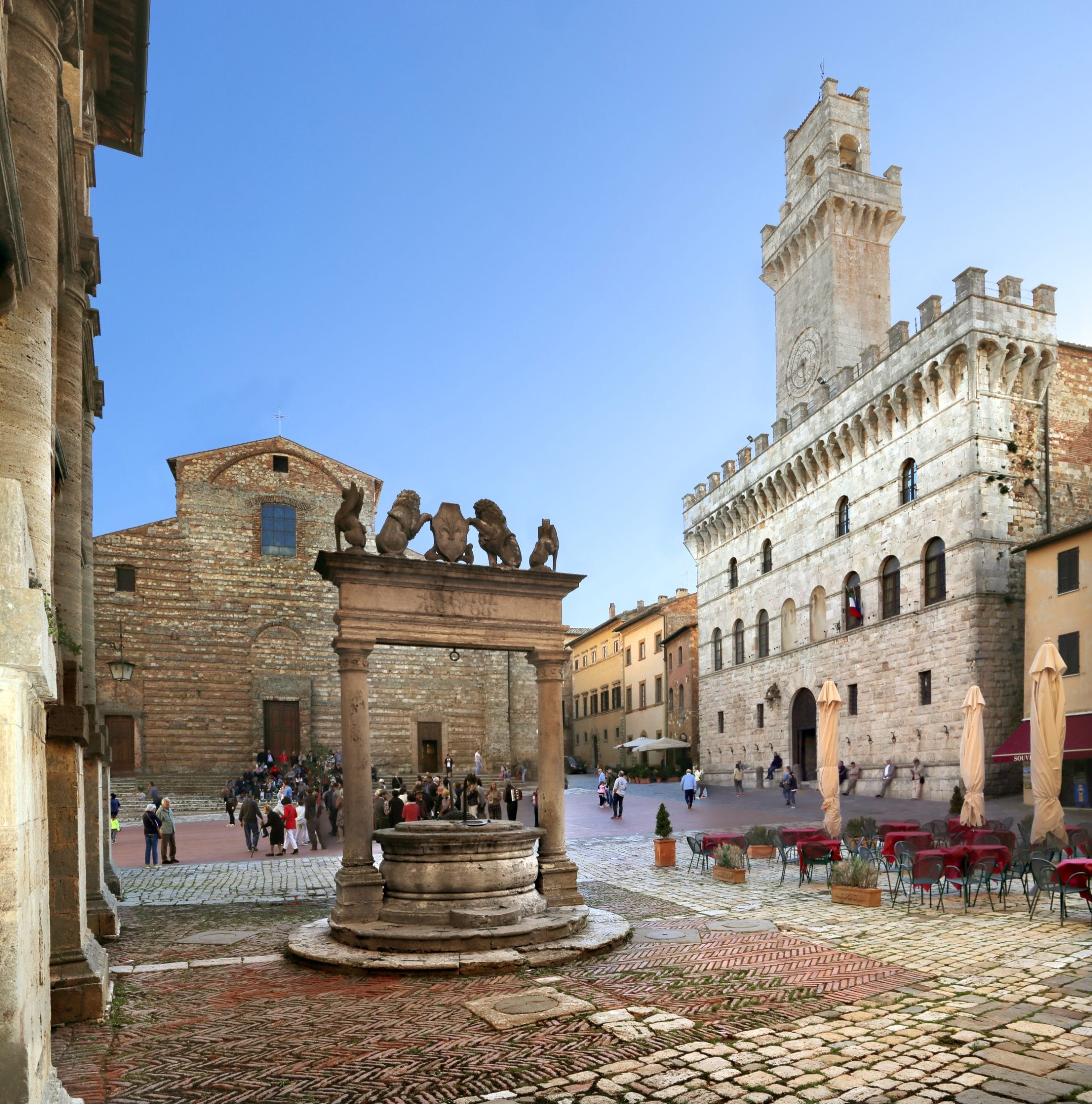
The great uphill main street, Il Corso, winds through the historic centre, lined with wine shops, artisan boutiques, and cafés. Walking its full length from Porta al Prato to Piazza Grande is one of the great Italian promenades.
Tempio di San Biagio
Just below the town walls, at the end of a cypress-lined avenue, stands one of the most celebrated Renaissance churches in Tuscany. Designed by Antonio da Sangallo the Elder and consecrated in 1529, its symmetrical Greek-cross plan in travertine stone is a masterpiece of High Renaissance architecture.

Vino Nobile di Montepulciano
Winemaking here is documented from 789 AD. By the 16th century, Pope Paul III’s sommelier called it “perfectissimo — a wine fit for a Lord.” The poet Francesco Redi declared it “king of all wines.” In 1980, Vino Nobile di Montepulciano became Italy’s first ever DOCG wine.
Made primarily from Prugnolo Gentile — the local clone of Sangiovese — it is dark cherry, plum, violet, and spice, with structured tannins and bright acidity that rewards ageing.
Angelo Poliziano
Montepulciano’s greatest son was born Angelo Ambrogini in 1454, taking his scholarly name “Poliziano” from the town’s Latin name. One of the foremost Renaissance humanists, he became tutor to the children of Lorenzo de’ Medici, translated Homer, and wrote La Favola di Orfeo — the first secular drama in the Italian vernacular. The estate winery Poliziano is named in his honour.

