
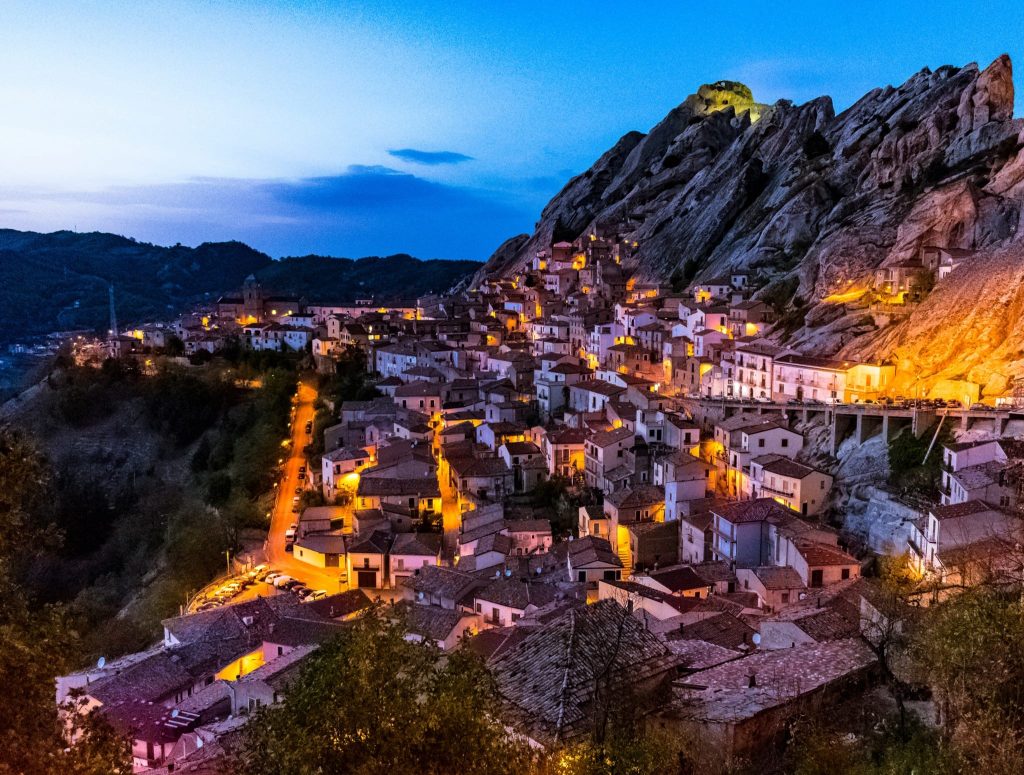
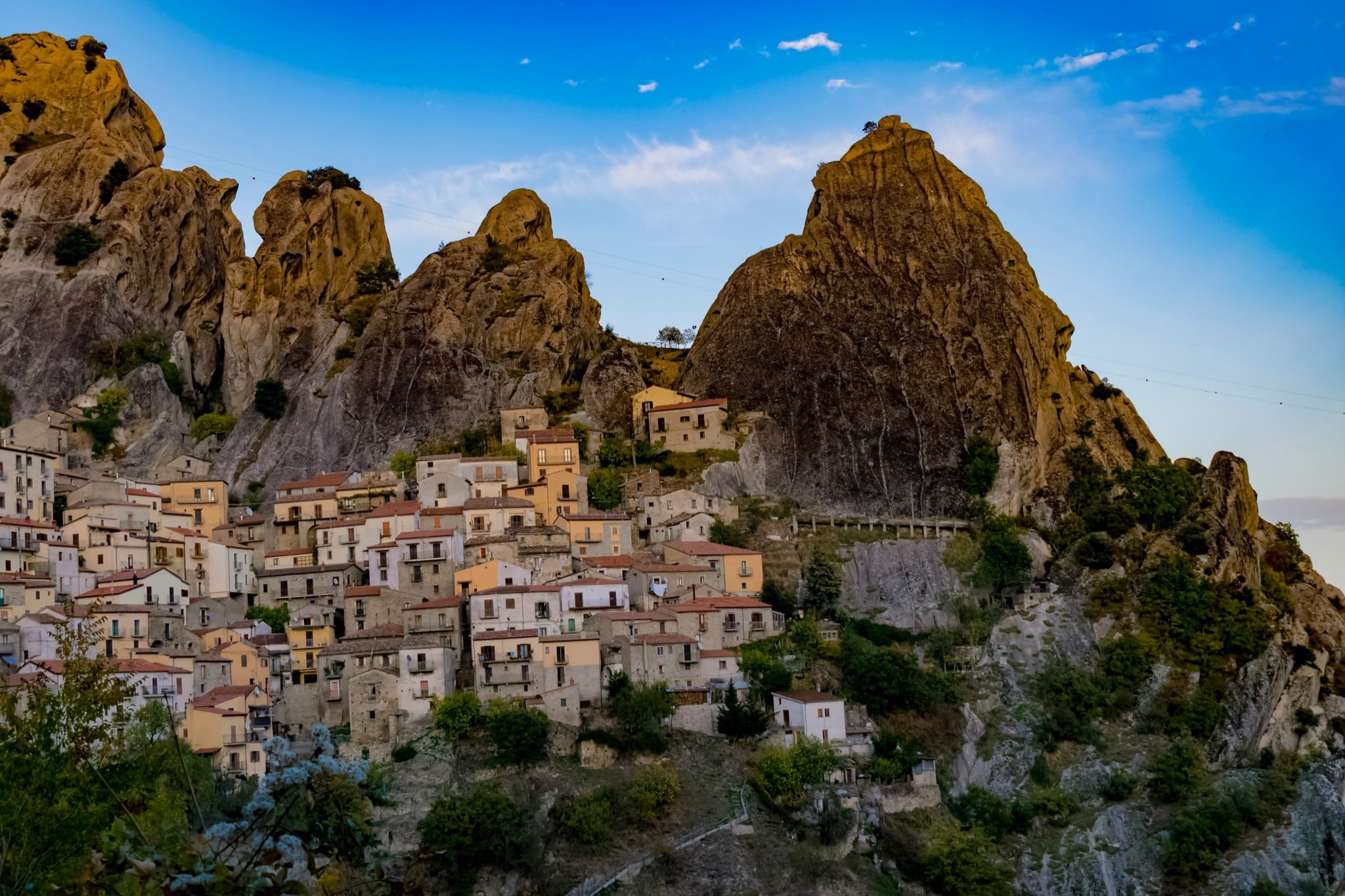
The Lucanian Dolomites are a cluster of dramatic sandstone spires rising above the Basento valley in the heart of Basilicata, protected since 1997 within the Parco Regionale Gallipoli Cognato e Piccole Dolomiti Lucane. The formations — named by popular tradition the Golden Eagle, the Anvil, the Owl’s Beak, the Great Mother, and the Lion’s Mouth — are made of middle Miocene sandstone (~15 million years old), carved by erosion into shapes that glow amber at dusk and pink at dawn.

The Ancient Lucanians
The Lucani — Oscan-speaking Samnite-Sabellic peoples, ancestors of the region’s name — built the major fortified city of Croccia Cognato on Monte Croccia between the 6th and 4th centuries BC, encircled by 2km of megalithic walls. Associated megalithic boulders called the Petre de la Mola have been identified as a probable solar calendar — a Lucanian Stonehenge — precisely oriented to the solstices and equinoxes.
The Saracens and the Arabata
In 838 AD, Saracen forces occupied the heights and established a stronghold at what became Pietrapertosa. The oldest quarter — the Arabata — preserves the Islamic street pattern: a labyrinthine district of narrow lanes, stone arches, cave dwellings, and blind alleys. Every August, the village celebrates this heritage with the Sulle Tracce degli Arabi festival.
Brigandage
After Italian Unification in 1860, the peasants of Basilicata faced new taxes, conscription, and governance from distant Turin. The resulting guerrilla resistance — led by figures like Carmine Crocco — found natural refuge in the mountain terrain of the Dolomiti Lucane, where a village perched on a cliff could roll boulders onto any advancing column.
The Great Emigration
No Italian region lost a higher proportion of its population. Between 1850 and 1900, approximately 125,000 Lucanians emigrated to the United States — roughly 14% of all Italian-American immigrants in that period, from a region that held perhaps 2% of Italy’s population. By the end of the 20th century, Castelmezzano had shrunk to under 800 people.

Carlo Levi
Carlo Levi’s Cristo si è fermato a Eboli (1945) — written about his Fascist-era exile in nearby Aliano — remains the canonical literary testimony to the structural abandonment of this peasant world by the Italian state.
The Rebirth
The tourist reinvention began with the park’s founding (1997) and the inauguration of the Volo dell’Angelo zip line in 2007 — a deliberately conceived economic development project by the two village councils that has since become one of southern Italy’s most visited adventure tourism destinations.