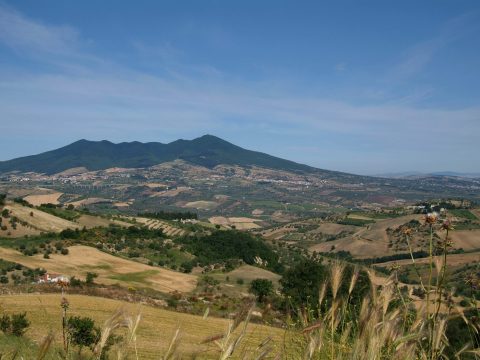
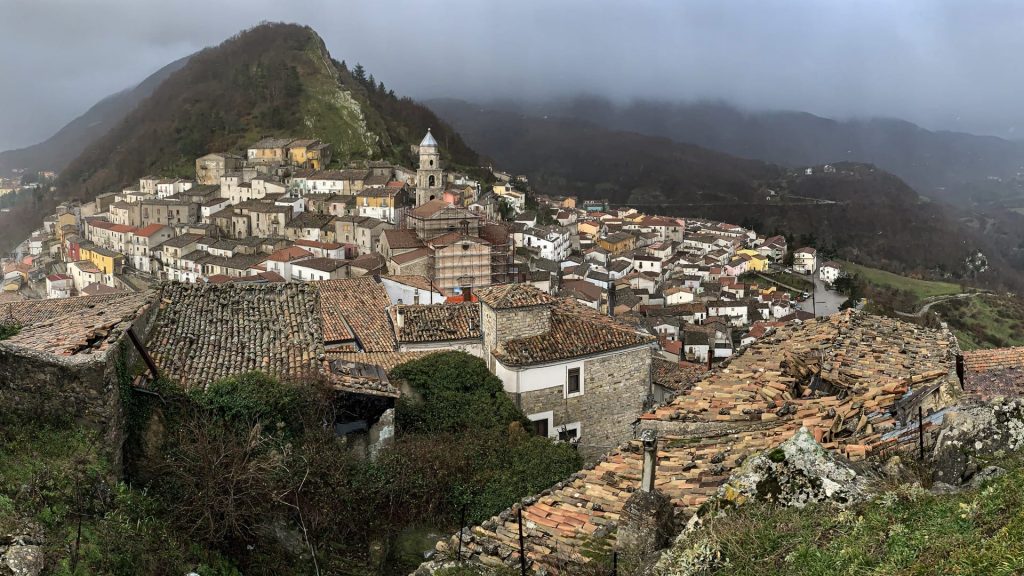
San Fele sits at 864 metres, perched at the saddle between Monte Toretta and Monte Castello, overlooking the Vitalba Valley. Founded around 969 AD when Holy Roman Emperor Otto I built a fortress to guard a mountain pass against Byzantine encroachment. The castle — now in ruins — once imprisoned Henry VII of Germany and Joanna of Naples.

A History of Power and Faith
Roger II and Pope Honorius II signed peace agreements here to end the clash between the Normans and the papacy. The town became a Caracciolo family fief in 1432, then passed to the Doria family of Genova in the 17th century — they were the final feudal rulers.
The Sanctuary of the Madonna di Pierno, at the foot of Mount Pierno in the Bosco Santa Croce woodland, is one of the oldest and most mysterious sanctuaries in Basilicata. The feast has been celebrated annually since 1139 AD. And it was the banner of this Madonna — carried by San Felesi emigrants — that flew at the very first Italian festa in America, at St. Joachim’s Church in Five Points, New York, in 1888. Mother Frances Cabrini participated in that first procession.
The Waterfalls
The Cascate di San Fele — locally called ‘U Uattënnièrë after the gualchiera (fulling machines) that powered textile mills along the river until the 1940s. Ten waterfalls along 8 kilometres of trails, created by the Bradanello Stream cascading through the Lucanian Apennines. Stone remnants of the old mills are still visible.

The Cascata delle Gemelle (Twin Falls). The Cascata degli Innamorati (Lovers’ Waterfall) — featured in the RAI miniseries Il generale dei briganti about Carmine Crocco. The Cascata del Paradiso forms a swimming pool over 6 metres deep in summer.
Two main routes from the village: ‘U Urtone (1 km) and a longer 4 km path that takes about four hours. The trails are free and open.

The Emigration
San Fele’s population crashed from over 10,000 in the 1870s to roughly 3,000 today — one of the most dramatic depopulation stories in Basilicata. The first wave (post-unification through World War I) went primarily to the United States — New Jersey, Buffalo, New York City — and to Canada, Brazil, and Argentina. The second wave (post-WWII) went to Switzerland, Germany, Belgium, Northern Italy, and Australia.
Danny DeVito’s grandparents emigrated from San Fele to New Jersey. In 2016, the bronze sculpture La Famiglia by Antonio Masini was unveiled in San Fele, honouring all Lucanian emigrants. A replica stands in Sydney’s Canada Bay — the Basilicatan community there is large enough to have commissioned it.
The San Felese Society of New Jersey — formally the Unione e Fratellanza San Felese — was founded on April 10, 1902 in Trenton. It is the oldest Italian-American society in central New Jersey. Between 1880 and 1905, roughly two-thirds of Trenton’s Italian community were from San Fele.
The San Fele Association of Western New York, founded in 1998, holds reunions drawing over 300 people. San Felese immigration to Buffalo began with the Lombardo family in 1870 — until 1904, they were the pioneering Italian community in Western New York. St. Anthony of Padua Church on Court Street, which the San Felese were instrumental in founding, houses the Statue of the Madonna di Pierno.
Local Cuisine
Peperoni cruschi — dried, crunchy peppers, a Lucanian staple. Strascinata — hand-dragged fresh pasta served with local peppers and herbs. Aglianico wines from the surrounding Vulture vineyards. Mushrooms, truffles, wild boar, and handmade pasta.