
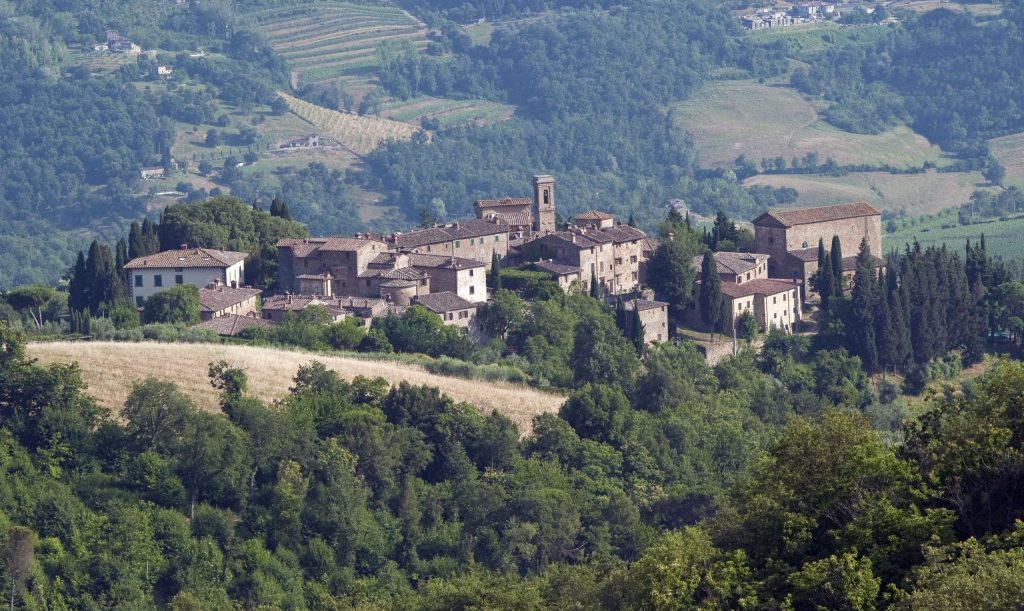
Forty-four people live in Volpaia. It is a walled hilltop hamlet perched at 617 metres above sea level, just north of Radda in Chianti — one of the most perfectly preserved medieval villages in Tuscany. Vineyards, cypress-lined lanes, olive groves, and oak woodland in every direction.
A Thousand Years of History
The castle was likely first built in the 10th or 11th century to defend the valley of the Pesa river, on the contested border between Florence and Siena. The first written mention of Volpaia dates to 1172 — the same year wine production here is first documented.
In 1250, Volpaia became a founding member of the Lega del Chianti, the Florentine military coalition whose emblem — the Black Rooster, Gallo Nero — was later adopted by the Chianti Classico consortium. It is now one of the most recognised wine symbols in the world.

The della Volpaia Family
The village takes its name from the della Volpaia family — architects, goldsmiths, mathematicians, and clockmakers. The most famous was Lorenzo della Volpaia (1446–1512), a friend of Leonardo da Vinci who advised him on technical problems and participated in discussions about the placement of Michelangelo’s David. Lorenzo built the Orologio dei Pianeti in 1510 and constructed the clock at the Palazzo Vecchio in Florence.
Castello di Volpaia — The Winery
Castello di Volpaia is the heart of the village — a celebrated example of how an ancient community can be preserved through winemaking. The estate was purchased in 1966 and remains in the hands of the Mascheroni Stianti family, today led by Giovannella and Carlo.