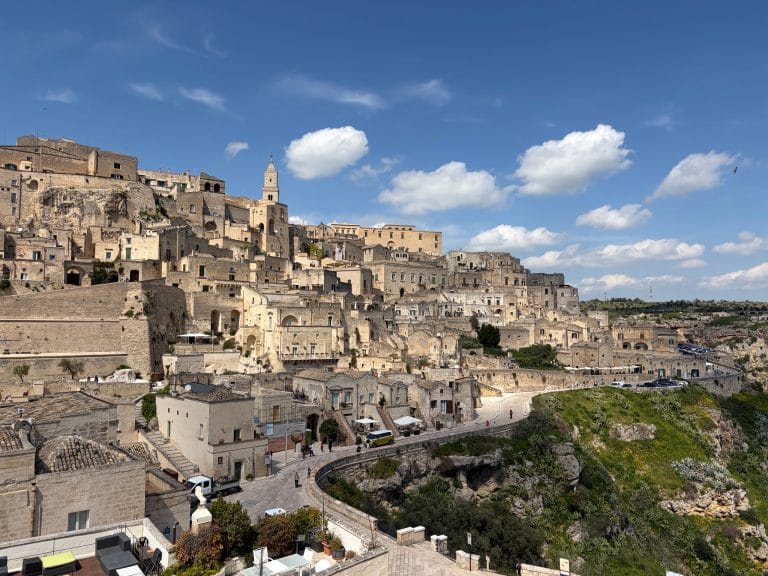
Pisticci
March 19, 2026
Pisticci is my family’s home town. As a child, I knew it as the place where the thin, blue envelopes marked Posta Aerea, containing letters from my paternal grandparents and my aunts, originated. My parents often talked about the home they left behind and especially about the hardship and poverty suffered during World War II. I finally saw Pisticci for myself when we spent the summer there in 1963, when I was 7 years old.
My memories of that trip are very hazy. My grandmother, dressed in Pacchiana, the traditional women’s dress, cooking in a pot over a wood fire. Picking figs and almonds from the trees in my Zia Rosa’s home in campagna, or countryside. Going to the beach every morning and being warned to be careful of the jellyfish.
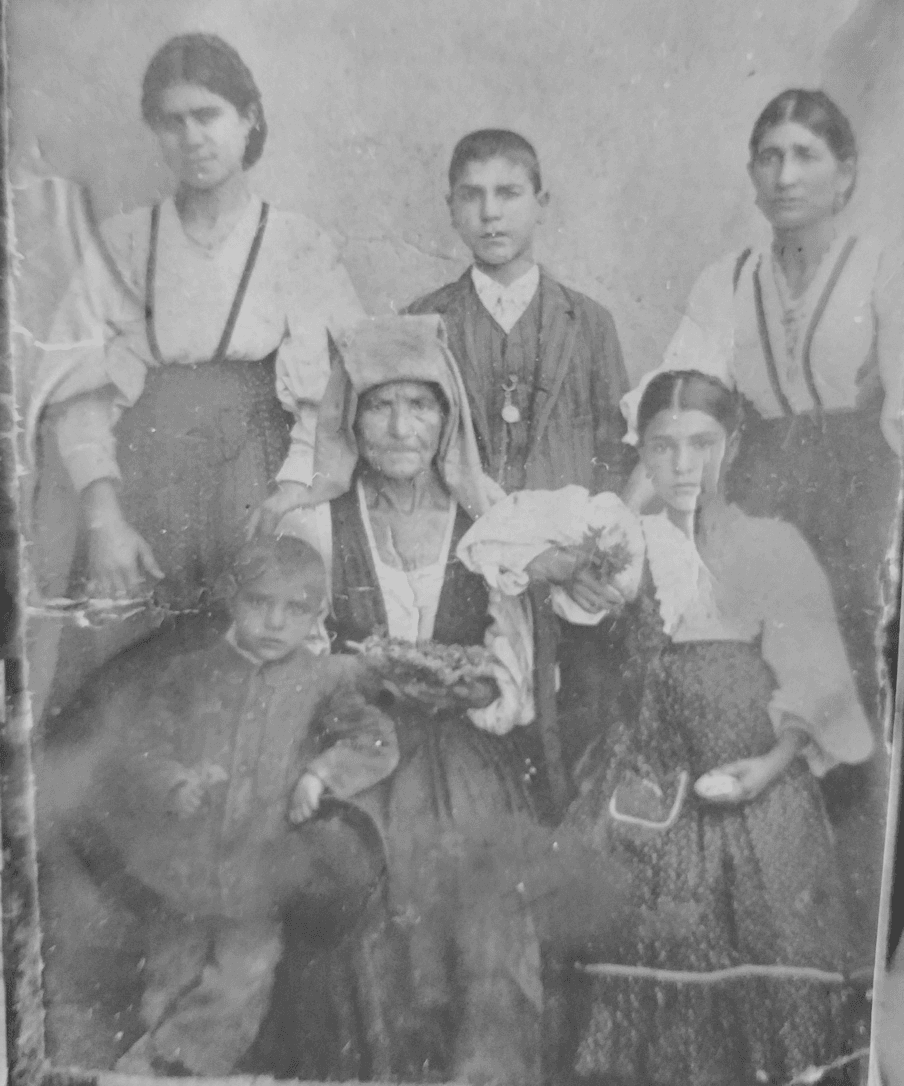
Photo taken approximately 1910, featuring my great-aunt (Pasqua Sardella), top left, who came to Canada in 1911 and sponsored my grandfather, mother and aunt to emigrate in 1950. Both she and my great-grandmother, Anna Maria D’Alessandro (centre), are wearing the traditional Pacchiana dress for women.
I’ve come to know Pisticci better over the last ten years through visits with Peter, David and, last fall, Giuditta, as we prepared for this trip. It has been emotional to walk the streets that my parents did as children and young adults before they made the decision to make a new life in Canada. The white houses of Pisticci, the churches and the cobbled streets have changed so very little in the 75 years since Mom, her teenage sister, my Zia Bianca and her father, my Nonna, left. The dialect of the region, which I speak fluently, is dying as young people speak the infinitely more sophisticated “true” Italian. My aunts and uncles are all gone, but I’ve developed valued friendships with my cousins and their children – some of whom I hope you’ll meet during our visit. It is an honour and a privilege to introduce you to this important part of our family history.
Pisticci is located 1,200 feet above sea level, at the top of one of the many hills we’ll see during our time in Basilicata. As is true of Basilicata as a whole, the town was inhabited and ruled over the centuries by Greeks, Normans, Byzantines and, in the first part of the 20th century, by the Fascists led by Mussolini.
The origins of the town date back to the 10th century BCE, when the territory was inhabited by the Enotri, an ancient Greek people of the Bronze and Iron Ages who colonized Basilicata and Calabria and were known as early masters of the science of grapes and winemaking. The Enotri, whose name translates to “people of the vine,” inhabited hilltop villages like Pisticci and are regarded as among the earliest settlers of southern Italy.
Pisticci later became an important center connected to the colony of Metaponto, which was founded by a small group of Greeks in search of new land to populate in the strategic centre of the coastline of the Ionian Sea. During the 3rd century BCE, Pisticci came under Roman control and developed into a significant agricultural centre.
In 1688, a landslide destroyed much of the town, resulting in about 400 deaths. The part of Pisticci now known as the Dirupo (which translates as “cliff”), was built on the ruins of that landslide.
Moving into the last century, a concentration camp was established in 1939 in Pisticci as a key detention site for anti-Fascist political prisoners and others deemed “dangerous” by the Mussolini regime. The camp, which was located in the area of Caporotondo – very close to where we’ll be staying at Hotel Torre Fiore Masseria – was initially a center of agricultural work for the detainees. But in June 1940, with Italy’s entry into the war, it also became a concentration camp for the internment of both Italian civilians and of foreigners. The camp operated until September 14, 1943, when a British Special Air Service (SAS) raid freed around 200 detainees. After the official closure of the Pisticci concentration camp, it became a displaced persons (DP) camp where some 18,000 refugees, including several Jewish ex-internees and displaced Italians, moved through the camp until the end of World War II.
Pisticci is now the most populous town in the province after Matera. Known as the “white town” of Basilicata, because most of the houses are, indeed, white, Pisticci is renowned across Italy for being the production site of Amaro Lucano, the caramel brown, bittersweet liqueur. Every family with roots in Pisticci has at least one bottle of Amaro Lucano in their home, to be enjoyed neat, chilled, with ice or orange zest, as a digestif after a meal or, more recently, as a base for cocktails. The recipe, created in 1894, contains more than 30 herbs and a mysterious ingredient, is handed down by members of the Vena family, who continue to jealously guard it.

Every town in Italy has a patron saint and for Pisticci, that’s San Rocco. You’ll see images of the saint, along with his dog, throughout the town. In 1656, Pisticci was spared from the plague that ravaged the region and since then, San Rocco has been celebrated on August 16, when everyone in town, and from across the region, joins the festival that includes an outdoor mass, procession and fireworks.
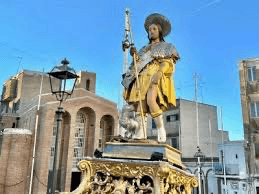
San Rocco (and his trusty dog) held high during the procession on the annual Feste di San Rocco on August 16 in Pisticci.
Some sights that our tour will include
Terravecchia, the highest and oldest part of the town from which, in 1688, the current district Dirupo collapsed. This hilltop area of town features a Norman castle, the ancient door of the village and the Chiesa Madre (or Mother Church), dedicated to the Holy Apostles Peter and Paul and built in Romanesque-Renaissance style in 1542–1544 as a temple on a pre-existing small gabled church dating back to 1212.
L’Abbazia del Casale, built around 1087 on the ruins of an ancient Greek-Byzantine monastery, the abbey was one of the shrines of the 2000 Great Jubilee, proclaimed by Pope John Paul II.
Piazza Johnny Lombardi was named for the Toronto-born son of immigrants from Pisticci. Lombardi was known as the “king of Little Italy” and the “father of multicultural broadcasting” for founding the CHIN radio station, home to broadcasting in 30 different languages. CHIN gives voice to the marginalized, serves to give newcomers to Canada a sense of comfort and familiarity, acclimatizes and integrates people into the Canadian mainstream and has helped launch Canadian talent in music and the arts.
The food of Pisticci
While in Pisticci, we’ll enjoy the traditional cucina povera cuisine typical of Basilicata – simple dishes of the peasant tradition with homemade pasta, vegetables and pork from which sausages and soppressata are produced. The typical pasta of the area are (in dialect): tapparédd (diamond-shaped), rucchëlë (concave dumplings), tagghiariédd (tagliolini) and orecchiette. Rucchëlë are usually cooked with rapini, while tagghiariédd are served with chickpeas, beans or peas. Typical vegetables are broad beans and dandelion greens – which are often paired with pureed fava beans (faf and ciuquèrë).
You can read more about this kind of food on my Substack, which I’ve named Dandelion Greens.