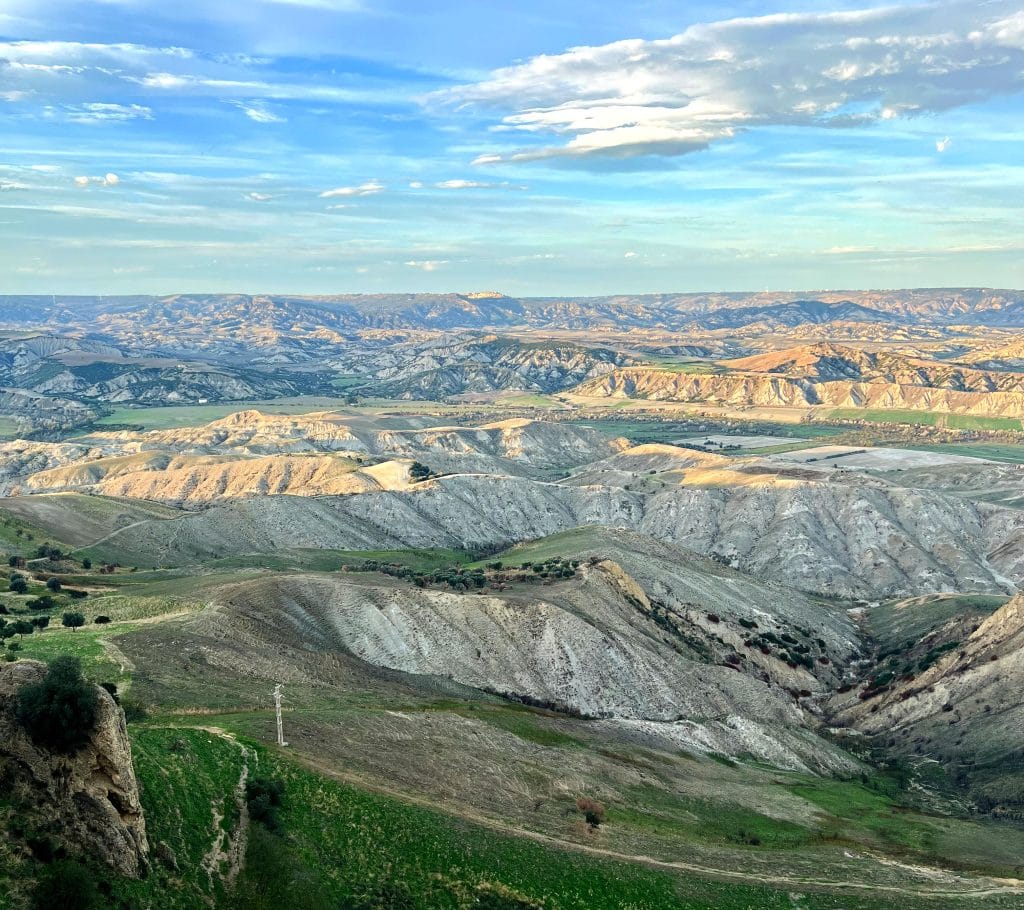
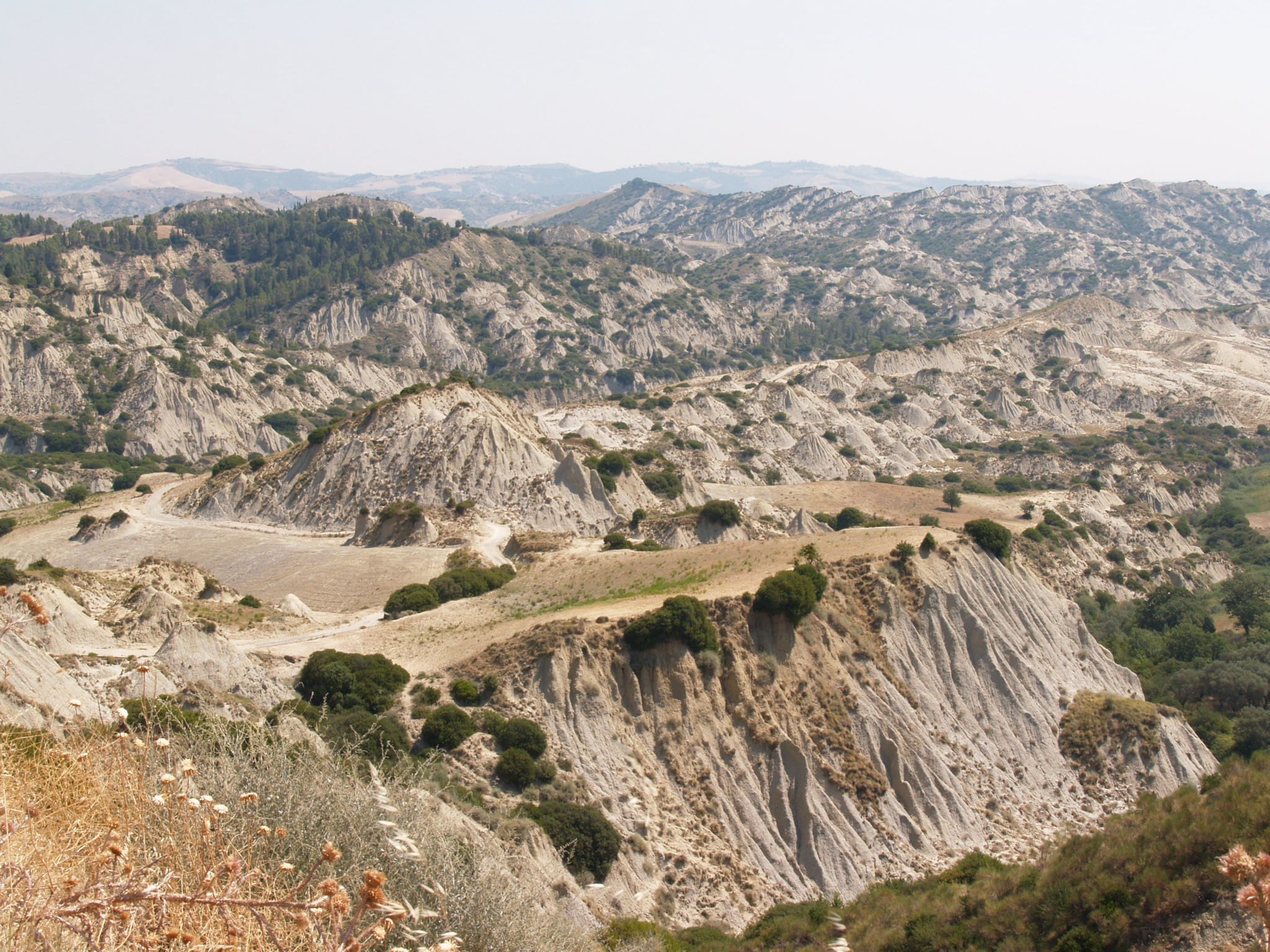
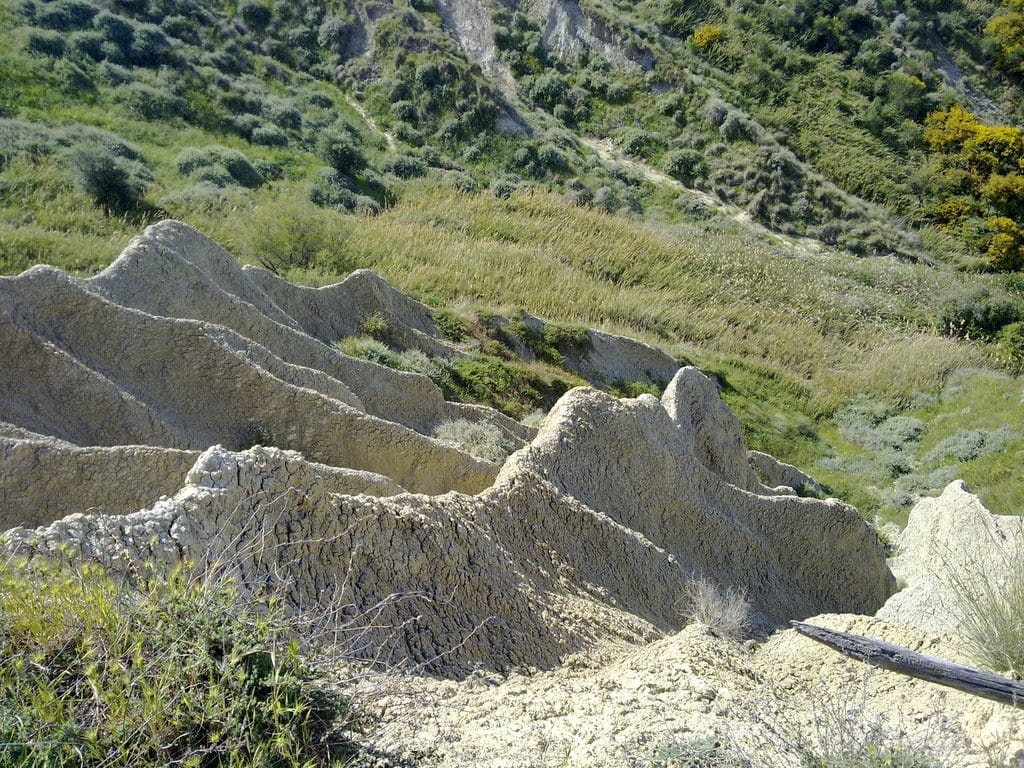
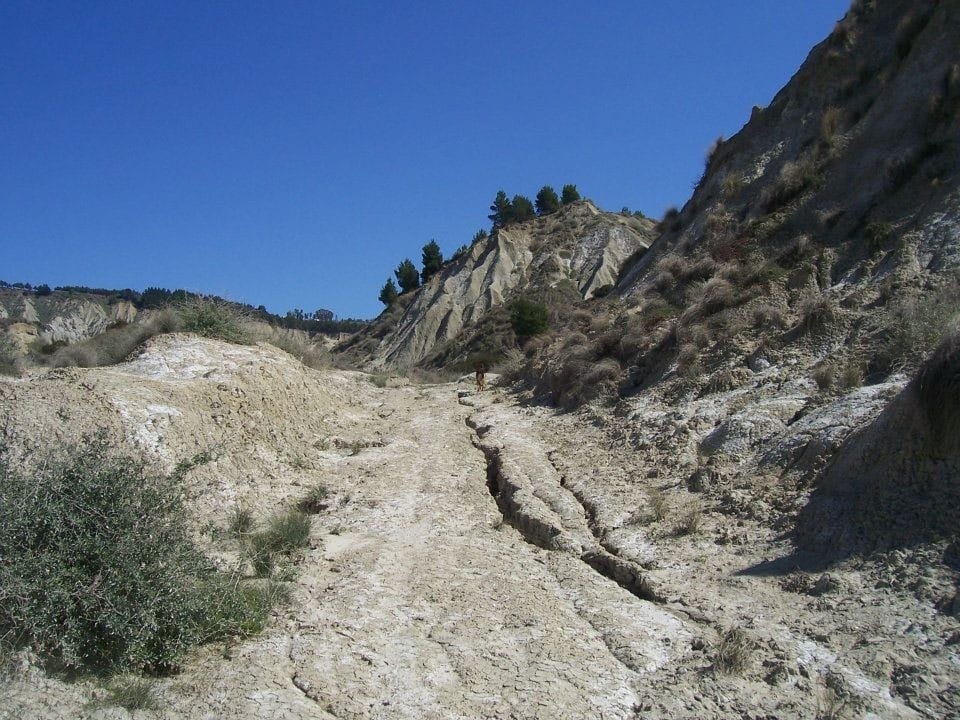
Calanchi are the defining landform of inner southeastern Basilicata — a system of deeply incised, bare clay gullies, razor-backed ridges, and pale eroded slopes that cover vast stretches of the landscape between the Lucanian Apennines and the Ionian coast. The effect on the eye is startling: an almost totally vegetationless world of off-white and grey clay sculpted into parallel fins, cones, and chasms, rising and falling across hillsides like a petrified ocean.
The Geology
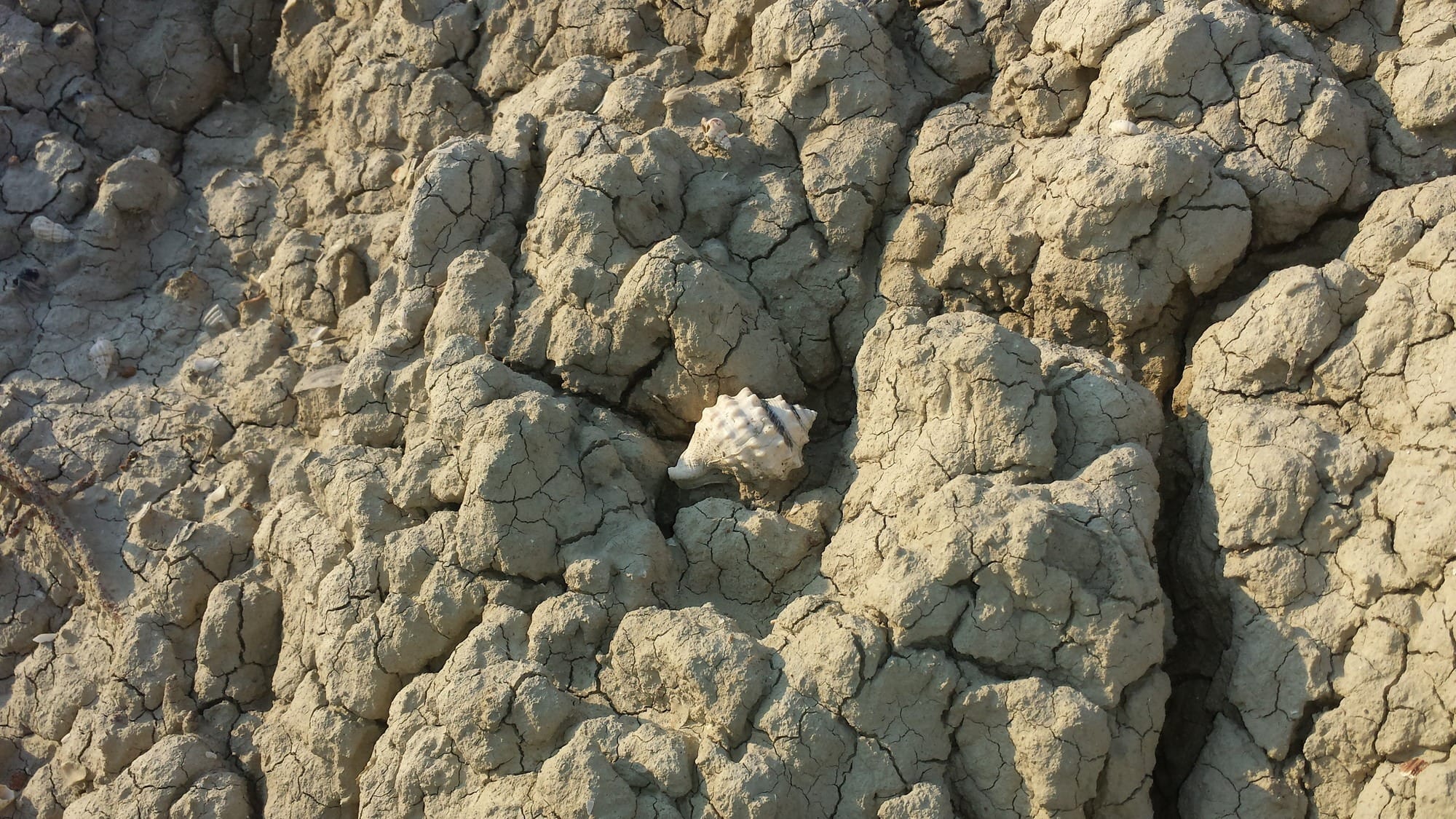
Calanchi form where Plio-Pleistocene marine clays are exposed at the surface with minimal vegetation cover and subjected to the semi-arid climate of the Basilicata interior. The clay is highly dispersible: when water hits an unprotected slope, it runs off instantly, cutting deep parallel gullies separated by knife-thin ridges.
The Montalbano Jonico section records the Lower-to-Middle Pleistocene transition (~780,000 years ago) and has been proposed to the International Commission on Stratigraphy as a global “Golden Spike” reference standard — one of the few such candidates in the world.
The Human Story
The calanchi are not simply natural. Deforestation from the 16th century onward stripped vegetation from clay hillsides. Post-unification land fragmentation and the great emigrations of the late 19th century accelerated the process. Terraces and drainage channels were abandoned.
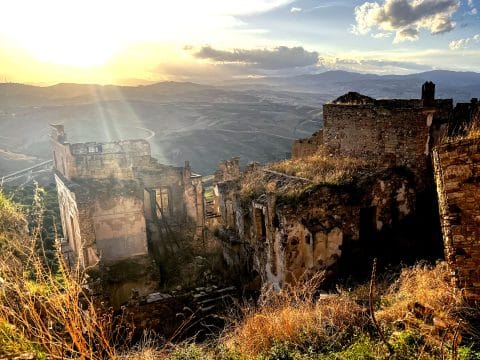
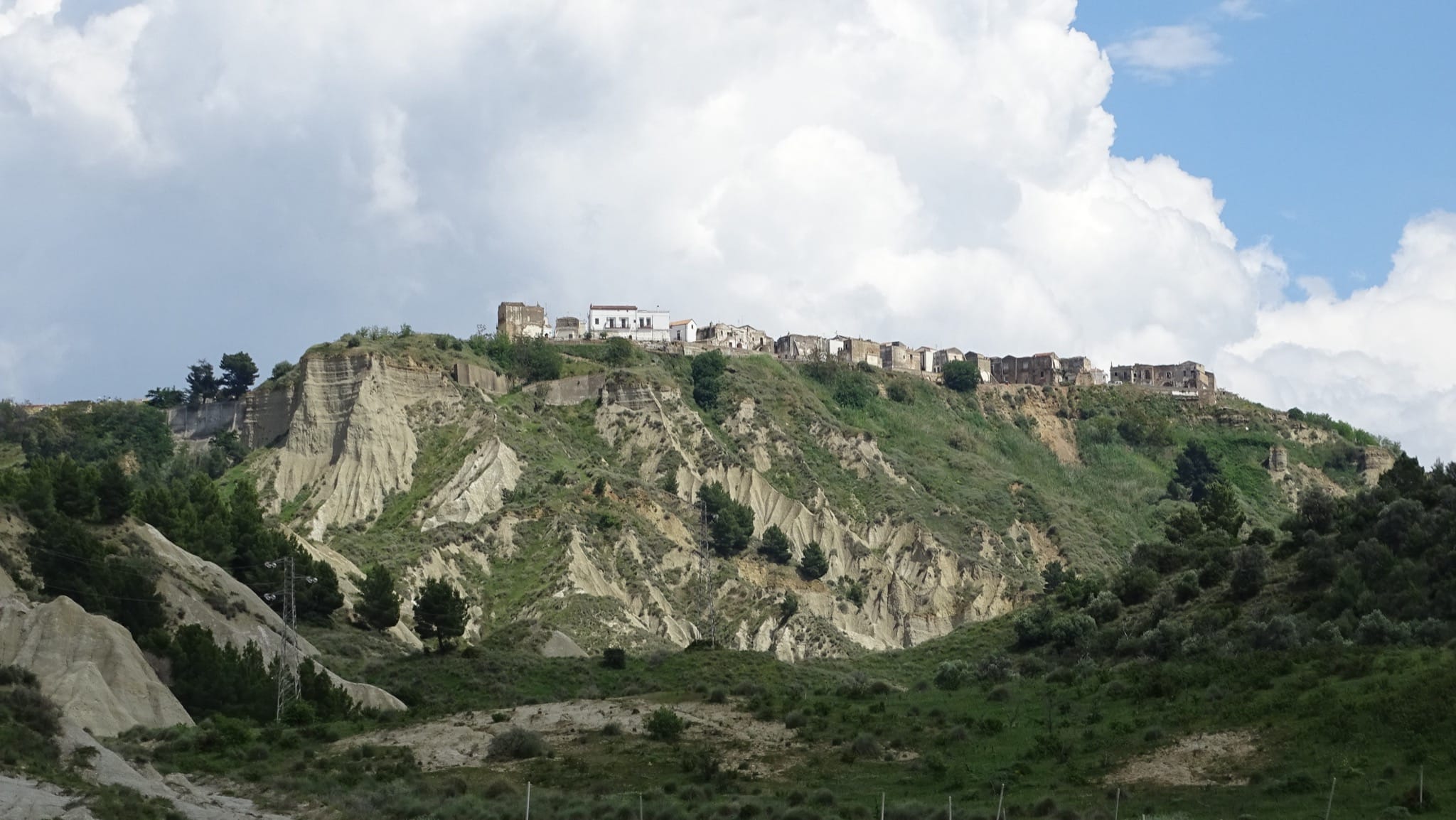
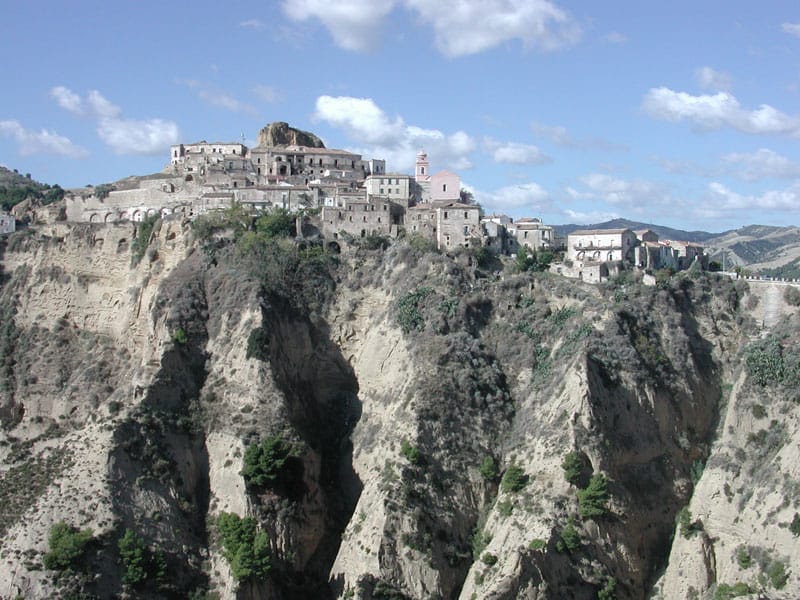
Every village in the calanco zone was built on a defensive hilltop of the same unstable marine clay. As populations grew, buildings crept down the clay slopes. Craco.
Tursi and the Rabatana
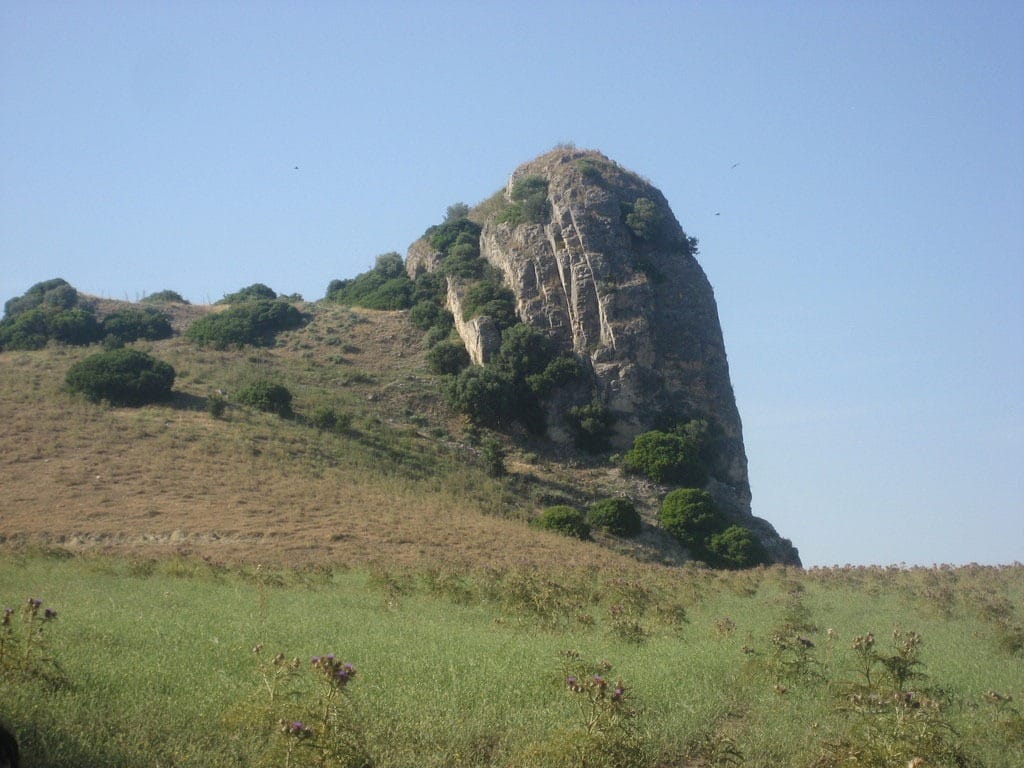
The town of Tursi sits above the calanchi, its ancient Arab-founded quarter — the Rabatana — perched on a cliff overlooking the clay landscape. The nearby Santuario di Santa Maria d’Anglona, an isolated Romanesque church, rises from a hilltop framed by the eroded clay formations.
Carlo Levi
Carlo Levi spent his political exile (1935–36) in Aliano, at the heart of the calanco country. His descriptions of the landscape in Cristo si è fermato a Eboli (1945) became the canonical literary text of this terrain. He wrote of “the endless expanse of dry clay, without a sign of human life, waving under the sun as far as eyes could see.” The calanco landscape around Aliano is now the Parco Letterario Carlo Levi; the village preserves his house, a museum, the Pinacoteca with his paintings, and his tomb.
Cinema
The landscape’s otherworldly visual quality has made the Craco/calanco zone one of the most filmed locations in Italy: Christ Stopped at Eboli (Rosi, 1979), The Passion of the Christ (Gibson, 2004), Quantum of Solace (Forster, 2008), and many others.
Visiting the Calanchi
The Riserva Naturale Speciale dei Calanchi di Montalbano Jonico (established 2011, 2,800 hectares) is managed by Legambiente’s CEA I Calanchi. Guided visits and self-guided trails are available; the ancient mulattiere (mule tracks) connecting hilltop towns to their valley gardens are among the highlights.
Best season: spring (April–May) for wildflowers against the clay; autumn (October) for soft light and cooler temperatures.