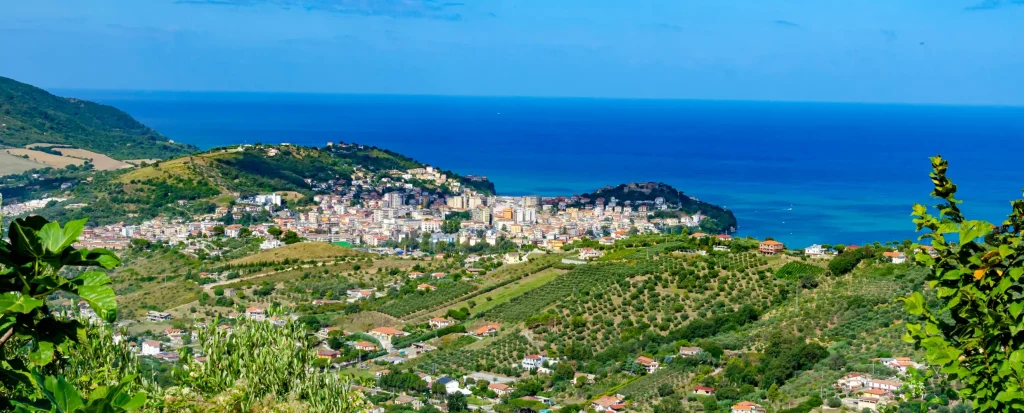
Maratea is the only comune in Basilicata on the Tyrrhenian Sea — the region’s entire western coastline is concentrated here. Known as La Perla del Tirreno, it is not one place but a constellation of settlements strung along the coast and hills: the medieval Borgo, the ancient ghost town of the Castello, the harbour at Porto, and a string of coastal hamlets — Acquafredda, Cersuta, Castrocucco — connected by one of Italy’s most dramatic coastal roads.

The Cristo Redentore
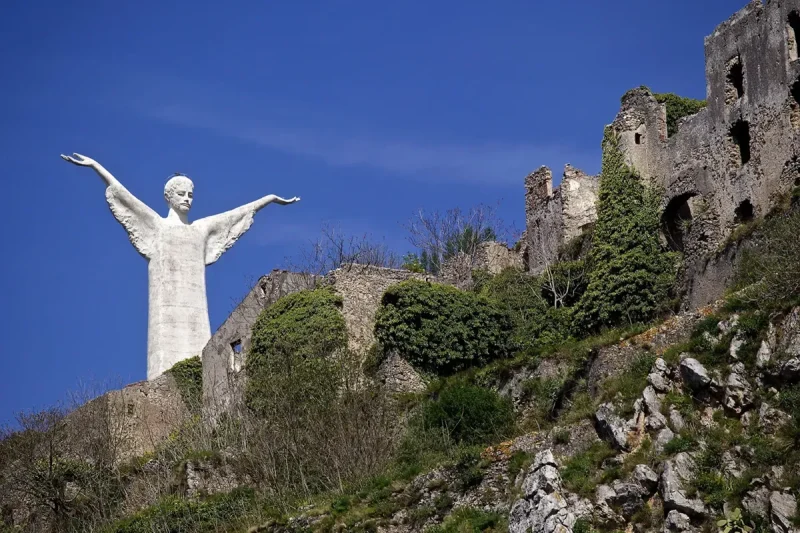
The defining landmark — a 22-metre statue of Christ on the summit of Monte San Biagio (644m), commissioned by industrialist Count Stefano Rivetti after a visit to Rio de Janeiro and sculpted by Florentine Bruno Innocenti between 1963 and 1965. Reinforced concrete faced with Carrara marble. Arm span 19 metres. Third-largest Christ statue in Europe.
Unlike Rio’s Christ, which faces outward to the city, Maratea’s faces inland — arms outstretched toward the Basilica di San Biagio. Innocenti described it as “a calm appeal to receive and collect, to strengthen hope.”

The Basilica di San Biagio
Built in the 6th–7th century on the site of a temple to Minerva, directly facing the Cristo Redentore. It houses the silver relics of Saint Blaise, brought to Maratea in 732 AD by a ship fleeing Byzantine religious persecution. Every year on the second Sunday of May, the silver statue is carried in procession down to the Borgo.
The Borgo
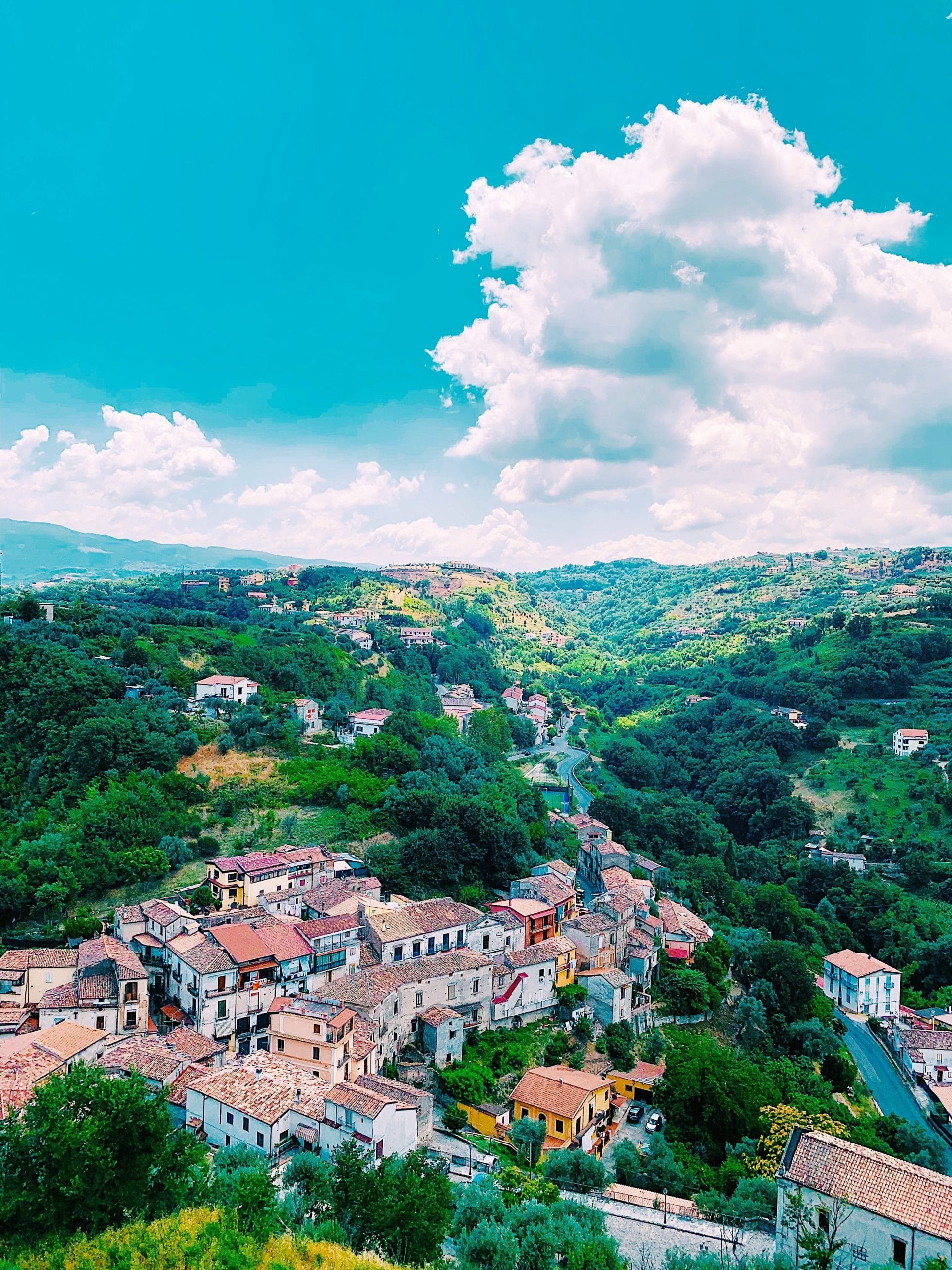
A perfectly preserved medieval hill town — narrow stone-paved lanes, tiny piazzas, stone archways. The medieval street plan survives intact. Above it, Maratea Castello — the original hilltop settlement — is now largely uninhabited ruins, beautiful in its decay.

The Coast
Thirty-two kilometres of coastline alternating steep rocky cliffs with secluded coves and sandy beaches — some accessible by road, many only by boat. Blue Flag Acquafredda. The dark volcanic sand of Cala Jannita. One hundred and thirty-one documented grottos. The SS18 coastal road — narrower and more dramatic than the Amalfi Coast — hugs the cliffs for 22km with cantilevered curves suspended above the sea.
History
Greek trading post in the 15th century BC. The name probably derives from Marathéa — fennel in Medieval Greek, the same root as Marathon. Byzantine period, then Saracen raids forced the population uphill to Monte San Biagio. The Normans came in 1077. When Napoleon’s brother was proclaimed King of Naples, Maratea’s mayor held the castle with 1,000 men before surrendering after a three-day siege. Post-unification emigration to the United States and Venezuela funded the town’s modernisation — railway in 1894, aqueduct in 1902, electricity in 1924.