My grandmother’s seadas
How a Sardinian dessert helped me find my way
Jump to Giuditta’s recipe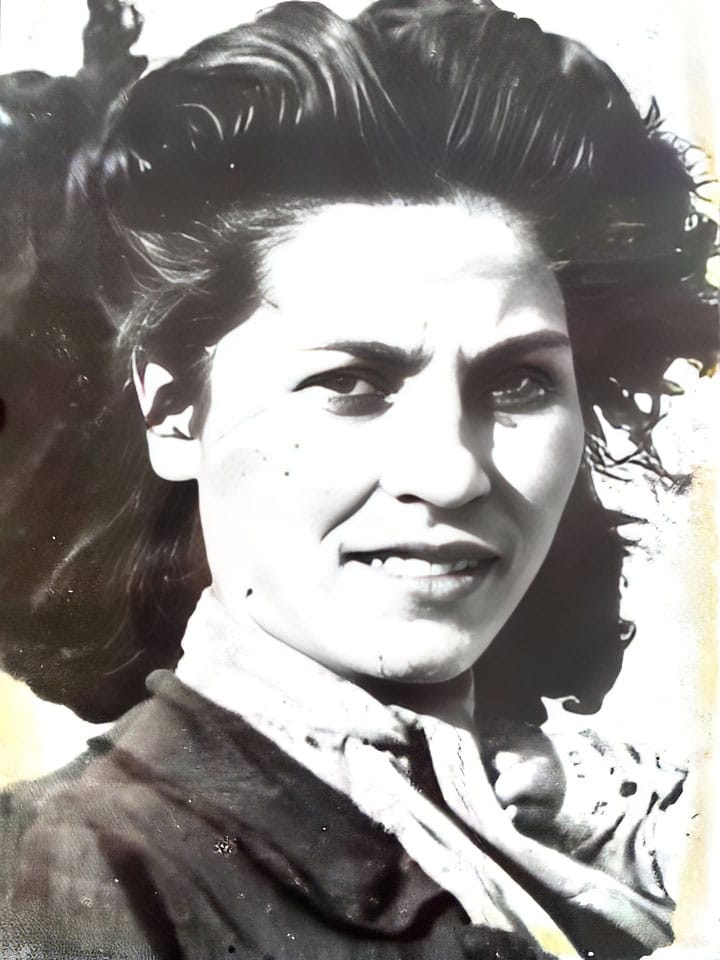
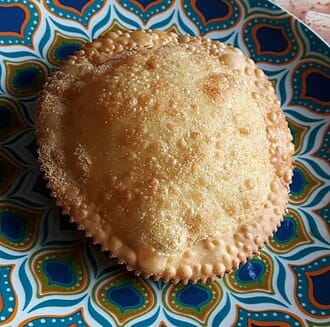
When I was growing up in Antella, we often ate Sunday dinner with my Sardinian grandmother in her apartment. For dessert, she served seadas—semolina pastry filled with pecorino cheese. She deep-fried them in olive oil, then drizzled bitter honey on top while they were still hot. She made big batches and froze them, so she’d always have some for us.
You don’t find seadas in Tuscany—it was a treat I could get only at her house.
When she lived in Sardinia, in Tempio Pausania, she used miele di corbezzolo, honey from the flowers of the wild strawberry tree, famous for its bitter taste. You can’t find miele di corbezzolo in Tuscany, so she used miele di castagno (chestnut tree honey) instead.
Then I moved away, first to study linguistics in Siena, then to teach at the university in Grenoble, and I left Italy behind. My favorite restaurant was Lebanese. I traveled to South America, to New Zealand, to Asia. I visited my family in Florence, and most of my friends were Italian, but I was a citizen of the world.

Then I got married and moved across the ocean to Oregon. And suddenly, I didn’t know who I was. I’d lost my friends, my work, and the Italian culture I hadn’t even known was important to me.
I started compulsively cooking the dishes of my childhood. Pici al cavolo nero. Latte alla portoghese. Spaghetti alle vongole. Pan di ramerino. I bought a pasta maker and made my own pasta. I started a cooking class to teach Italian cooking.
And—in my kitchen in Eugene, Oregon—I made my Sardinian grandmother’s seadas.
Eventually, I found my way. But cooking seadas and all the other recipes was how I took the first step of acknowledging my Tuscan and Sardinian identities.
Get Bitter Honey recipes and stories in your inbox.
You’re subscribed!
A welcome email should arrive within the next minute or so. If you don’t receive the email, please check your spam folder.
Can I ask you to do me a favor? Please click the “confirm” button in the email. That way, I’ll know it reached you.
Feel free to reach out to me with any questions.
Thank you!
— Giuditta ()
PS: Add my email () to your contacts and you’re guaranteed to receive my newsletter.
Unsubscribe anytime; I’ll never spam you or share your address.
Bitter Honey will always be free for everyone. —Giuditta
Recipe
- 4 cups (500 grams) of unbleached all-purpose flour
- About 1 cup (250 milliliters) cold water
- 4 tablespoons (50 grams) of butter (my grandmother used lard)
- Pinch of salt
- 10 ounces (300 grams) of pecorino cheese, cut into fine slices
- Olive oil for frying (or canola oil if you prefer)
- 3/4 cup (250 grams) honey. I use regular honey, but if you can find bitter honey, use it!
- Mix the flour and salt, then slowly add the cold water, mixing all the time, until you have a silky consistency. Add the butter and knead until well mixed. Cover and let rest for 30 minutes.
- Roll the dough out to be about 1/8 of an inch thick, then cut into 24 rounds about 4–5 inches wide (you can use a bowl or a pastry cutter).
- Place a few slices of cheese in the center of a round of dough, then put another round of dough on top. Press the edges together with your fingers, or with a fork. The fork looks better 🙂
- Gently warm the honey in a bain-marie (heat water in a pot, put the honey in a smaller pot inside the larger pot).
- Fill a wide pan with olive oil to a depth of about an inch. When hot, fry the seadas until golden on both sides (you can either flip them, or just spoon the hot oil over the top).
- Remove from the pan and place on paper towels.
- Drizzle the honey over the top and serve while hot.
Gluten-free instructions
I haven't made a gluten-free version of this recipe, but here's where I'd start. I'd love someone to try this and tell me how it goes!
- Use Caputo Fioreglut in place of the all-purpose flour, gram for gram. One note: it's safe for celiacs but not for a wheat allergy. If you have a wheat allergy, use King Arthur Measure for Measure and stir 10 grams of whole psyllium husk into the water first.
- Use warm water instead of cold. Start with 300 milliliters, then add a tablespoon at a time. After each addition, mix for a minute before deciding if you need more.
- Stop when it's tacky, not silky. You want a dough that leaves a faint film on your fingers, but doesn't stick to your palm. If there are still dry crumbs in the bottom of the bowl, it needs more water no matter how the ball looks. Mix 3 to 5 minutes in total, then let rest for the full 30 minutes. The dough will firm up, which is why you want to stop while it's still a little wet.
- Test it. After the rest, pinch off a piece the size of a walnut, flatten it, and fold it in half. If the crease cracks, the dough is too dry: knead in a tablespoon of water, rest another 10 minutes, and test again. When it folds clean, it's ready.
- If you're unsure, go wetter.
Everything else stays the same! If you try it, tell me how it turns out — and how I can improve it!
The Bitter Honey Project
The recipes the women and men of the Italian diaspora carried across the water, and the stories behind them.
Recent posts
 Two sisters making zeppoli and nacatoli with love
My mother Caterina was 13 when she crossed the ocean with her little sister Elisa—
from Calabria, Italy to Melbourne, Australia
Two sisters making zeppoli and nacatoli with love
My mother Caterina was 13 when she crossed the ocean with her little sister Elisa—
from Calabria, Italy to Melbourne, Australia
 My mother’s torrone di mandorle
The aroma of Christmas
My mother’s torrone di mandorle
The aroma of Christmas
Get Bitter Honey recipes and stories in your inbox.
You’re subscribed!
A welcome email should arrive within the next minute or so. If you don’t receive the email, please check your spam folder.
Can I ask you to do me a favor? Please click the “confirm” button in the email. That way, I’ll know it reached you.
Feel free to reach out to me with any questions.
Thank you!
— Giuditta ()
PS: Add my email () to your contacts and you’re guaranteed to receive my newsletter.
Unsubscribe anytime; I’ll never spam you or share your address.
Bitter Honey will always be free for everyone. —Giuditta
Do you have a recipe? .My dream is to connect our hometowns in Italy with all the places we ended up—through the recipes of our mothers and grandmothers.— Giuditta
Share this post
Watch the Instagram Reel
View this reel on Instagram