You’ve probably seen Val d’Orcia before.
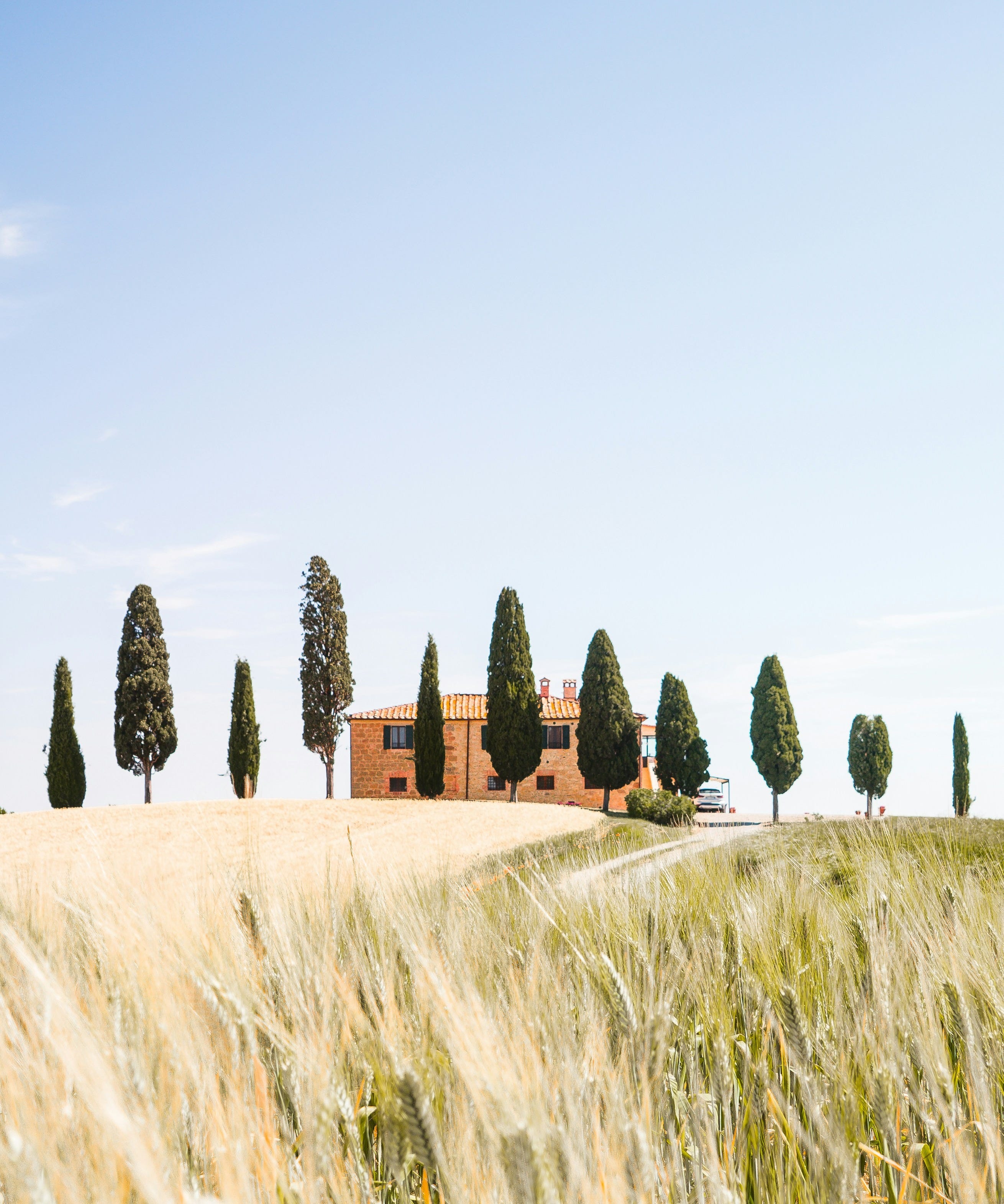
It’s the Tuscany of the collective imagination: rolling hills, cypress trees, that golden light. Val d’Orcia is the perfect postcard, and a dream destination for photographers.
But places like this don’t become meaningful because they were filmed, photographed, or chosen by someone famous (hello, the Obamas). They become meaningful when you start digging a little deeper and asking different questions:
Who lives here? Who works this land every day? What choices are being made quietly, far from the postcard?
This is how I see Italy, my home country—not only as a collection of beautiful views, but as a web of people and bumpy relationships. Lots of ups and downs. In short… the real stuff.
And this is how I love to design my tours: by introducing you to the people who give a place its depth, real people beyond its image.
I value beauty deeply, especially as a gateway to awe. But without context, beauty doesn’t stick with us for long.
Val d’Orcia is famous for its pecorino di Pienza, a delicious sheep’s cheese made with raw milk. And once you stay here long enough, once you really look at those hills, a question becomes almost inevitable:
So… where are the sheep?
The answer is less romantic than the postcard suggests. The cheesemakers who moved from Sardinia in the 1970s originally raised sheep locally for cheese production. In recent years, however, to cut costs, some producers have started buying milk from outside the region—sometimes even from other European countries—and transforming it locally. It’s efficient. And it’s legal.
But not everyone chooses that path.
I wanted to meet Ulisse, at Podere Il Casale, because he’s an outsider. As I’ve written before, outsiders are often particularly good at truly seeing a place.
Together with his wife Sandra, Ulisse arrived in Val d’Orcia in the early 1990s, coming from Zurich’s punk and countercultural scene. They were looking for a different way of living: producing their own food and creating a space where artists could experience a communal life.
What they found was Podere Il Casale: a run-down farm with no electricity and no running water. Not exactly the dream. But for them, it was radical and deeply liberating (though for Sandra, who was 38 weeks pregnant at the time, it understandably took a little longer to adjust).
Today, Podere Il Casale is a farm-to-table restaurant and artisanal dairy producing pecorino di Pienza exclusively from their own sheep’s and goat’s milk. Everything comes from their land: olive oil, wine (or grape juice if you don’t drink alcohol), flour for bread and pasta. The only meat—rarely found on the menu—is goat or sheep.
Well, almost everything. They buy their salt from the Adriatic coast.
No shortcuts.
Ulisse has a gentle German accent, and first and foremost, he’s a shepherd. But part of his work is also education. He shares what it really means to farm today—without romanticizing it or sugarcoating it.
Meeting people like Ulisse and Sandra is like peeking through a window into a Val d’Orcia most travelers never get to see.
And they’re not the only outsiders who helped me understand this landscape more deeply.
Like Ulisse and Sandra, Pamela Sheldon Johns is an outsider—someone whose presence has blended seamlessly into the region through deep curiosity and a profound respect for local culture.
Born in California, she settled at Poggio Etrusco in the Montepulciano area over forty years ago. Over time, by attuning herself to the rhythms of daily Tuscan life, she became one of the most knowledgeable voices on cucina povera—the traditional, peasant cooking of the region, all about seasonal, simple ingredients stretched in many ways.
Spending time with Pamela isn’t about a simple cooking class. It’s about stories. Stories that reveal the social and historical layers behind the food we eat. One of my favorites is about her outdoor oven. Shortly after buying the property, she discovered by chance that it was actually a communal oven. Every Tuesday, she was expected to light it so neighbors could come and bake their bread. Unaware of this unspoken tradition, one morning she found a woman with dough in hand, glanced at the cold oven, and walked away. Small moments like these show how deeply food is woven into community and daily life.
With Pamela, you don’t just learn what Tuscany tastes like, you experience it.
Val d’Orcia is also shaped by people who intervene in less expected ways, by reimagining how the land itself can be used.
One of my favorite discoveries is Puscina Flowers, a flower farm run by three sisters passionate about sustainable floral design. When they started in 2014, there was nothing quite like it in Italy—growing seasonal, local, organic flowers for weddings and design was virtually unknown in rural Tuscany. Inspired by Northern Europe and the U.S., they brought a new way of seeing and using the land.
Their journey wasn’t easy. Convincing suppliers, clients, and even neighbors that a flower farm could thrive here took years of dedication. But today, Puscina Flowers is both grounded and dreamy—a space where you can experience the rhythms of the seasons, the patience required for growth, and the beauty that comes from deep care and connection to the land. And, for sure, one of the most beautiful lunch settings in the valley.
Visiting them isn’t just about seeing flowers. It’s about understanding a vision and the creativity —and maybe even bringing some of that inspiration home with you.
Over the years, I’ve learned that places reveal themselves through people—the farmers, the cooks, the creatives who intertwine their personal stories and craft with the landscape.
That’s why the Val d’Orcia tour isn’t about ticking off sights. It’s about creating space for these encounters and traveling in a way that gives value and visibility to the people who shape this place every day.
No matter what, I want these people and places to be known. Because Val d’Orcia is not just a beautiful landscape—it’s a living one.
And if this way of traveling resonates with you, I’d love to share it with you, on the Val d’Orcia journey.
Originally published on Giuditta’s Substack →
Get a new story like this every two weeks.
SubscribeYou’re subscribed!
A welcome email should arrive within the next minute or so. If you don’t receive the email, please check your spam folder.
Can I ask you to do me a favor? Please click the “confirm” button in the email. That way, I’ll know it reached you.
Feel free to reach out to me with any questions.
Thank you!
— Giuditta ()
PS: Add my email () to your contacts and you’re guaranteed to receive my newsletter.
Unsubscribe anytime; I’ll never spam you or share your address.

