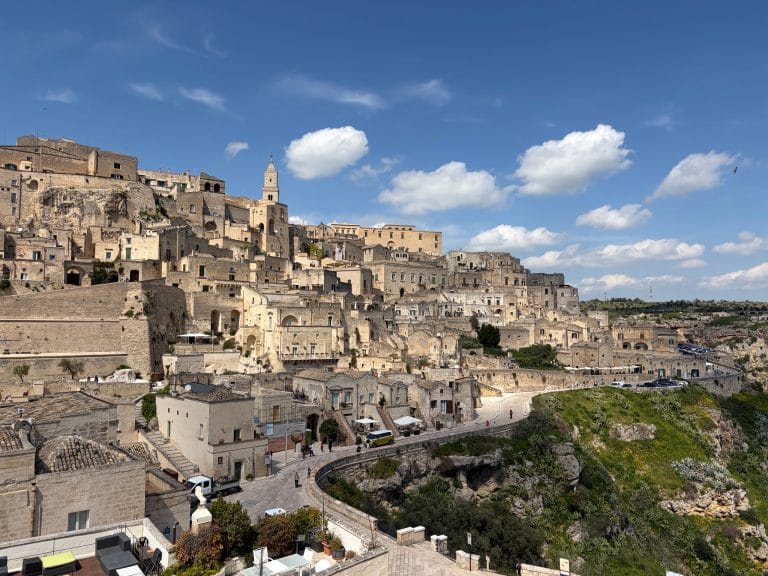
Craco Lives Within Us
March 1, 2026
Joe wrote this reflection to be read to the members of the Return to Basilicata Tour as they stand in Craco in front of the house where he was born.
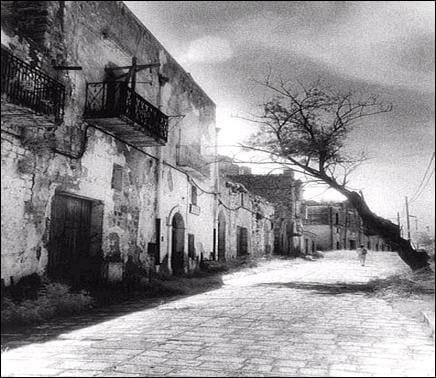
You are standing just outside the house where I was born — a small stone home that belonged to my grandfather, Francesco Rinaldi. In 1961, ten of us lived inside: my parents, my grandmother, and seven children. I was the youngest. When my family left Craco in 1967, I was only six years old. What I carry with me are fragments — flashes of memory like pieces of old film: our house, my grandmother’s kitchen, the piazza, the soccer field, and the narrow alleyway where I once fell and broke my nose.
Life here in the early 1960s, as in much of Basilicata, was not easy. My parents had married in 1943 and built their life within these walls. Like most families, we farmed land handed down through generations. Each day, my parents walked on foot to their fields. The soil was sparse, the harvests uncertain. Then came the heavy rains and the landslides that began to wound this hill. My father used to say he felt as though a noose was tightening around his neck — each year a little tighter. That is why, in 1967, we left for Canada.
The first time I returned to Craco as an adult, I was twenty-eight. I was unprepared for what I would see. The landslide had taken much of the town, and what remained stood silent and abandoned. The people had been relocated to Craco Nuovo in the valley below. I remember standing here, heartbroken. The places that lived in my memory were gone. The house where I was born still stood, but it was unsafe to enter. I longed to step inside and find my childhood waiting for me but time and nature had already moved on.

Much of my experience of Craco was shaped not so much by memory, but by stories. My siblings told of playing soccer until darkness fell, of pranks played on teachers, of apprenticing with the town seamstress, of the strict rules that governed young courtships. Around the fire, we heard stories of superstitions, of gypsies who might steal children, of hidden treasures buried in the countryside. Life was hard, yes, but it was rich in family and community.
Craco followed us to Canada. We arrived in Toronto to a world of refrigerators, washing machines, and telephones — luxuries we had never known. Yet something essential felt missing. My mother adapted her recipes with whatever ingredients she could find. In the 1960s, being Italian in Canada was not fashionable. As a six-year-old, I begged my mother to use soft white sliced bread for my school lunches because the other children teased me about my thick Italian bread. We learned English. We adapted. We worked hard to belong.
But inside our home, Craco lived on. In spring we celebrated Easter with roasted lamb and home made taralli. In summer my father planted tomatoes, peppers, zucchini, cicorie, parsley, and basil. My mother preserved tomato paste for the winter. In the fall we made wine. At Christmas, seafood filled our table on Christmas Eve, followed by savory zeppole and sweet chestnut-filled pastries. In January, there was salami and pancetta. Through these rituals, my parents ensured that although we had left Craco physically, Craco never left us.
Today, as you walk these streets, I hope you do not see a ghost town or a cemetery of what once was. Look beyond the silence. Imagine women kneading dough and carrying it a few doors down to the Forno Cisterna to bake. Imagine children running through the alleys, men returning from the fields, neighbors gathering in the evening air to share news. Imagine feast days filled with music and devotion. This hill once pulsed with life. Craco’s buildings may be fragile, but its spirit is not. Like the words of John McCrae in In Flanders Fields — “If ye break faith with us who die, we shall not sleep” — places like Craco ask something of us. They ask us not to forget. They ask us to carry forward the language, the recipes, the stories, the faith, the traditions.
When you leave here today, I hope you carry with you not sadness for what was lost, but gratitude for what was lived, and a quiet commitment that the memory of Craco, and all that it represents, will continue to live wherever its people call home.