Everyone’s seen the pictures: a medieval town standing empty on a bare hill, its tower and churches open to the sky, its streets empty.
But Craco’s people are alive. They live in the valley below the old town, and in New York and New Jersey, in Canada, in Argentina, in Australia. They call themselves Crachesi.
The town on the cliff
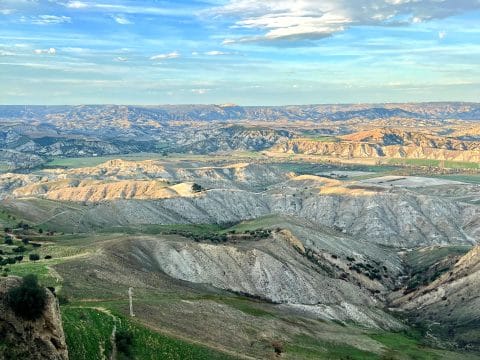
Craco sits on a clay hilltop 400 meters above the Cavone River valley, in the province of Matera, fifty kilometers inland from the Ionian coast. On every side are the calanchi, the pale clay badlands of inner Basilicata, ridged and bare where centuries of rain have cut them into blades. You drive up through them, and then the town appears above, medieval against the sky. The hill is the reason Craco exists. It is also, as it turned out, the reason Craco fell.
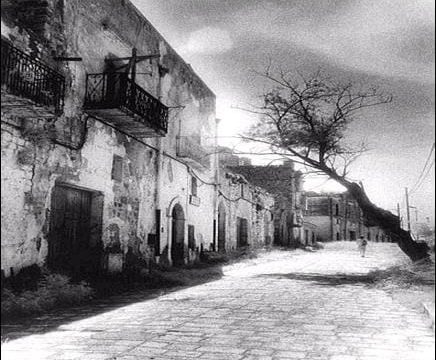
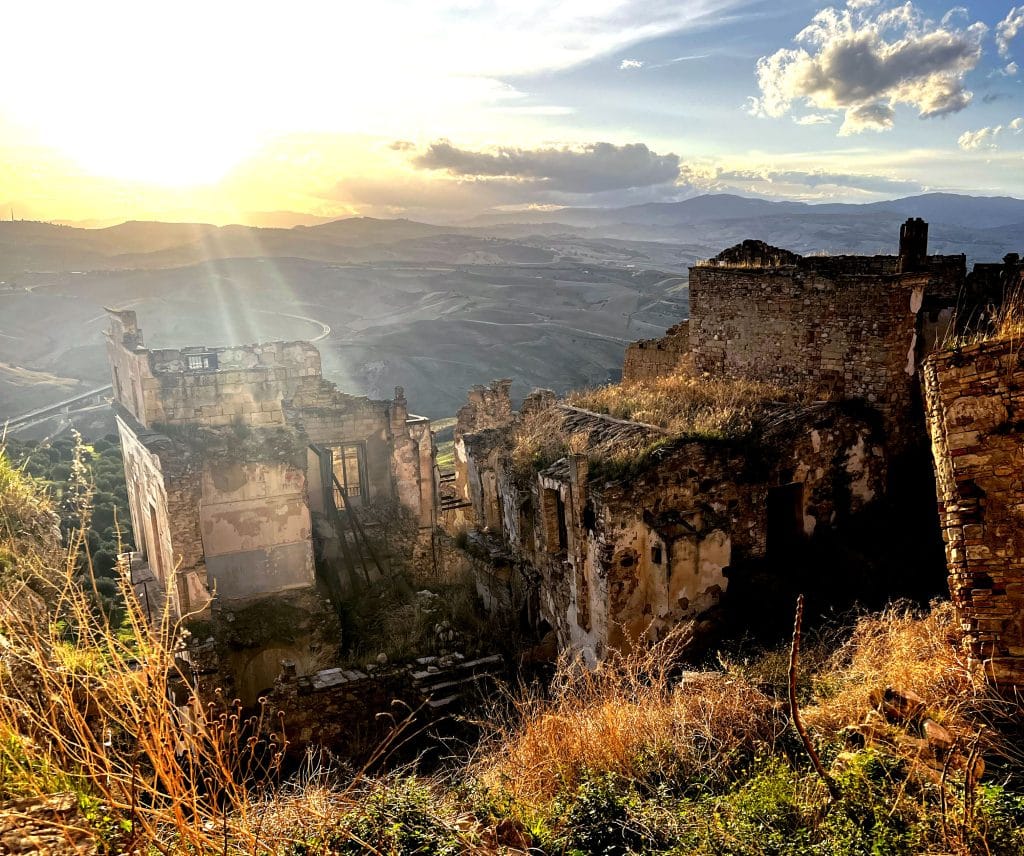
From a distance the town looks whole. The Norman tower still stands. The church fronts are still there, and the maze of streets still suggests ordinary life. Up close, the loss is staggering. Roofs are open to the sky. Floors lie under landslide earth. Plants grow through the walls and up the stairwells. In the church of San Nicola, weeds come up at the altar. An eighteenth-century pipe organ sits in ruins. The town is slowly taken back by the hill.

A very old town
People have lived on and around this hill for a very long time. Tombs in the area date to the eighth century BC. Greek settlers came inland from the coast in antiquity, and a later tradition remembers Greek monks who gave the place the name Montedoro, “mountain of gold.” The first written record of the town is from 1060, when the land belonged to Arnaldo, Archbishop of Tricarico, who called it Graculum, from a Latin word for a small plowed field. That name is a clue to what kept Craco alive for nine hundred years: the wheat grown in the valleys below. The town’s coat of arms is an arm gripping three golden sheaves of wheat.
By the Middle Ages Craco was a real town, not a village. Its defensive tower dates to around 1040. In 1276 it became a universitas, the medieval word for a self-governing town, a mark of genuine standing for a place this size. By 1561 some 2,590 people lived there, near its historical peak. The town passed through a long line of feudal lords, ending with the Vergara family, who were made marquesses of Craco in 1712 and dukes in 1724, and it grew up around the palaces of its noble families.
Craco lived through the hard history of the Italian South. Plague struck in 1656, part of the great epidemic that killed roughly half of Naples. In 1799 the Crachesi rose briefly against their Bourbon lords in the short-lived Parthenopean Republic. During the Napoleonic years brigands attacked the town, and after Italian unification in 1861 the most feared brigand of all, Carmine Crocco, took Craco. Through all of it, people stayed, rebuilt, and worked the fields.
San Vincenzo, the patron saint
At the center of Craco’s identity is a saint. San Vincenzo Martire was a Roman soldier of the Theban Legion, a legion of Christian soldiers recruited in Egypt, who were put to death in the year 286 for refusing to make a pagan sacrifice. His feast is kept on the fourth Sunday of October, and as far as anyone knows, it is kept in only two places on earth: Craco, and the Crachesi community of New York.

His relics came to Craco from Rome in two stages. A small bone relic arrived in 1769. Then, in 1792, a Franciscan of Craco named Father Prospero brought back the “sacred body,” a wax figure of a reclining Roman soldier holding the martyr’s palm, made around the saint’s remains, which had lain in the catacombs of Santa Ciriaca in Rome. It was received first at the little chapel of Santa Maria della Stella outside the town, then carried in procession up to the friary of San Pietro, which the people of Craco came to call, simply, the Convent of San Vincenzo. The town chose him, alongside San Nicola di Bari, as its protector.
When the old town was abandoned, the saint moved with his people. The relic rests today in a small chapel in the Sant’Angelo quarter, the one corner of old Craco still sound enough to enter. So many Crachesi took his name across the generations that a search of the town registry found 527 people christened Vincenzo or Innocenzo between 1850 and 2005.
How Craco was lost
Craco was not killed by an earthquake. It was killed by its own plumbing.
The hill is made of clay, the same unstable clay that forms the calanchi all around it. The town stood through the great earthquakes that shook Basilicata across the centuries, in 1456, 1694, 1857, and 1930. Landslides came — and the town rebuilt. For nine hundred years the people managed the water on the hill with a careful system of cisterns, keeping it at the surface, away from the clay.
In the twentieth century the town modernized. It laid in an aqueduct, then sewers and pressurized water pipes. The pipes leaked. Water that had always been kept at the surface now soaked down into the clay and saturated it from within. In 1963, after heavy rain, the slope finally gave way for good. The roughly 1,800 people still living there were moved down to a new settlement in the valley, Craco Peschiera. A flood in 1972 ended any hope of return, and the Irpinia earthquake of 1980 made it irrevocable.
Craco survived invasions, plague, brigands, earthquakes, and centuries of landslides. What finally brought it down was leaking pipes.
Why the Crachesi left
The other thing that emptied Craco was not sudden at all.
After Italian unification, the South was left poor, and the promises of the new nation did not reach places like Craco. Beginning in the 1880s, and heavily between 1892 and 1922, the Crachesi left. Roughly 1,300 of them crossed to North America, most to New York. They were part of one of the largest diasporas in the world: over the last two centuries, maybe half a million Lucani left Basilicata for the Americas, Australia, and northern Europe.
The Crachesi did not arrive with much. The ones who did best came with a trade: they were tailors, barbers, shoemakers. Those without a trade worked as laborers, and many went into the rag and waste-paper business, which the Crachesi came to dominate in New York and pass down through their families for generations. They settled together in Lower Manhattan, around Mulberry and Baxter and Roosevelt Streets, in the crowded blocks of what became Little Italy.
San Vincenzo in New York
What the Crachesi carried with them, above everything, was their saint.
On October 26, 1899, seven Crachesi men signed papers in New York to found a mutual-aid society, the Società San Vincenzo Martire di Craco, to look after one another and to keep the feast. Their names were Camperlengo, Cantasano, Marrese, Torraca, DeCesare, Rinaldi, and DeSisto.
In 1901 the Society brought San Vincenzo himself to America. The original bone relic of 1769 was carried by hand from Craco to New York, and the tailor Pasquale Marrese, one of the founders, made a statue of the saint in his shop, working from memory and from a woodcut the immigrants had brought with them. The first feast of San Vincenzo in New York was held that October. For half a century the Crachesi kept it, with a Mass and a procession through the streets, on the same fourth Sunday of October they had always kept in Craco.
When the founding generation passed and their societies faded, it was often the women who kept the saint safe. Women with names like Grossi, Niceforo, Gallo, and LoCicero cared for the relics and the statues, moved them from closing church to closing church, restored them, and paid for the Masses, across decades when almost no one else was watching. Because of them, the 1769 relic and the statue survive today, in the Shrine Church of the Most Precious Blood on Baxter Street, on the very block where the first New York feast was held in 1901.
The Crachesi today, and the Craco Society
In 2007, descendants of the Crachesi in the United States founded the Craco Society, the successor to that first society of 1899. It exists to preserve the history, culture, and traditions of Craco, and to hold them for the Crachesi people everywhere. Joe Rinaldi is its president, and it is the hub of the Federazione Lucana d’America. Much of what is known about the history of Craco was recovered by its members, who tracked down the old relics, the banner, the family records, and the story itself.
Joe’s letter
I want to end with Joe Rinaldi, because he says it better than I can.
Joe was born in Craco and emigrated to Canada in 1967, when he was six years old. For our tour in April, he wrote a letter to be read aloud in front of the house he was born in. This is part of it.
But inside our home, Craco lived on. In spring we celebrated Easter with roasted lamb and home made taralli. In summer my father planted tomatoes, peppers, zucchini, cicorie, parsley, and basil. My mother preserved tomato paste for the winter. In the fall we made wine. At Christmas, seafood filled our table on Christmas Eve, followed by savory zeppole and sweet chestnut-filled pastries. In January, there was salami and pancetta. Through these rituals, my parents ensured that although we had left Craco physically, Craco never left us.
Craco is not the broken walls on the cliff. It is the lamb at Easter and the wine in the fall and the name of a soldier-saint carried across an ocean. It is the Crachesi, in the valley and across the sea.

Visiting Craco
You can visit the old town, but only on a guided tour: the site is fenced and hard hats are required. The tour takes about an hour and runs through the main street, the central piazza still half-buried in landslide earth, the church of San Nicola, and the Norman tower, with its view across the calanchi. The former monastery of San Pietro now holds the MEC, the Museo Emozionale di Craco, with exhibitions on the town, the emigration, and the many films shot here, from Christ Stopped at Eboli to The Passion of the Christ and Quantum of Solace.