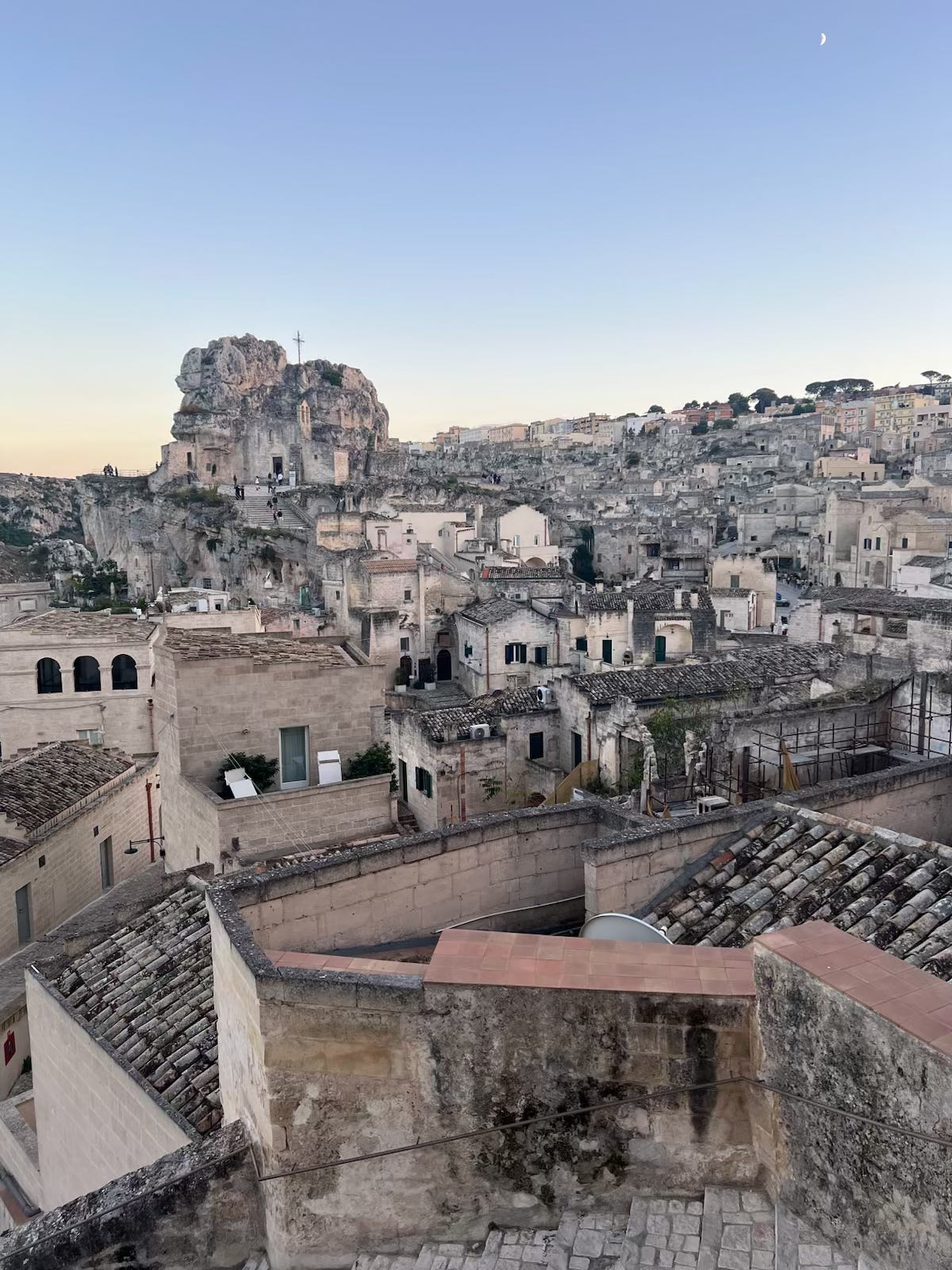
I visited Matera for the first time in November 2025, on a research trip preparing for an upcoming Spring tour.
As an Italian seeing this town for the first time, I was honestly speechless.
Matera is disorienting — in the best possible way. No matter where you are, you feel like you’re in the heart of the city, until you turn a corner and find yourself somewhere else that also feels like the heart. Among the Sassi, the ancient cave district, there is no periphery. Every angle is the center.
Then there was the view. When I filmed this short video from one of the overlooks, I felt genuinely puzzled. The colors, the canyon, the scale of the landscape — it didn’t feel like Italy at all. For a moment, it felt closer to Morocco or Algeria than anywhere I knew back home.
And then there’s the light. I’m not a photographer, but I’m deeply sensitive to it. Every place has its own specific quality of light. In Matera, at sunset, the way light reflects on the limestone is almost unreal — quiet, ancient, and absolutely jaw-dropping. This is the reason why during the Spring Basilicata tour we’ve decided to include one night in the Sassi, a choice against my usual preferred concept of having one home base for guests.
Growing up in Tuscany, I had always associated Matera with a phrase I’d heard since childhood: la vergogna d’Italia — the shame of Italy. The story I knew was about poverty and neglect: over 15,000 people living in cave dwellings without electricity or running water, until the government evacuated the Sassi in the early 1950s and relocated everyone to modern housing. A problem solved.
But in Matera, I heard another version. Patrizia, the owner of Panificio Perrone, told me that the real shame was never the people or how they lived — it was the Italian politicians who had spent decades ignoring them. And she offered another perspective I hadn’t considered: that the forced relocation, however well-intentioned, came at a cost. Life in the Sassi was built on an extraordinary closeness — neighbors who shared everything, a social fabric woven from proximity. Moving into modern apartments meant losing that. It was, she said, a kind of rupture. Not unlike what many of us experienced during Covid, when overnight, the texture of daily social life simply disappeared.
What surprised me most, though, was Matera’s relationship with its own future. In Florence, where I come from, the dominant question in tourism has long been how do we attract more visitors? In Matera, I sensed a different conversation, more far-sighted. What do we want this place to look like in 50 years? You can see it in the choices: the preference for considered, high-quality hospitality over cheap, high-volume options.
Matera is an absolute must. But know this: if you visit only this city, you are barely scratching the surface of what Basilicata has to offer, which is why our Spring tour goes much further than this one extraordinary place.
There’s an Italian word I keep coming back to: struggente. It means something between haunting and heartbreaking — the feeling of being moved by something so deeply that it almost hurts. Matera is struggente. And once you feel it, you’ll understand why I can’t stop thinking about it.
P.S: I’ll be in Basilicata this April. If this region has gotten under your skin the way it got under mine, follow along. I’ll be sharing the behind-the-scenes of both the scouting trip and the tour on my WhatsApp channel. Feel free to join 🙂
Continue Exploring
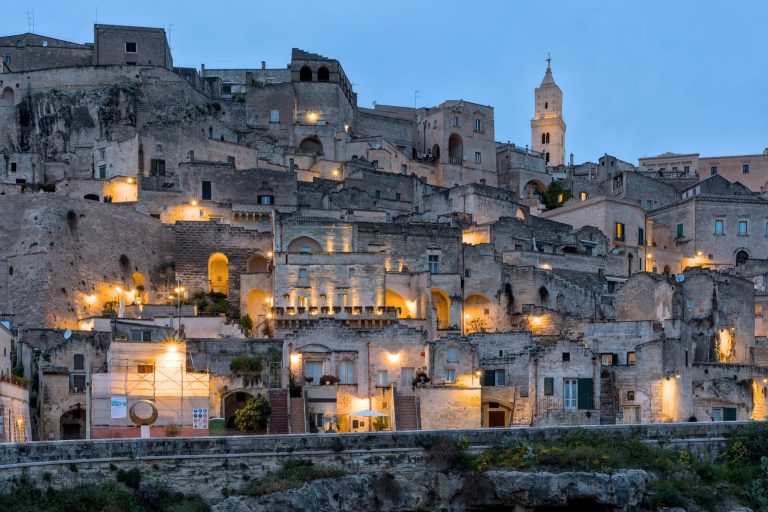
Matera
People have lived in these caves for almost 10,000 years. Our guests spend two nights here, sleeping in a hotel cut into the Sassi rock,…
Discover more →
Return to Basilicata
Reconnect with your roots in Basilicata, through the eyes of Adele Newton, whose family emigrated from Pisticci to Canada. Stay at a restored 16th-century farmhouse,…

Basilicata
Basilicata, also known by its ancient name, Lucania, is located in Southern Italy, on the arch of the boot. For most of the nineteenth and…
Explore region →